














How Is the Tonnage of a Die-Casting Machine Calculated? Formulas for Selecting Clamping Force and Projected Area + Examples
Excerpt:
Many engineers ask the same question when initiating a die-casting project: How do you calculate the tonnage of a die-casting machine? If the tonnage is too low, the high pressure of the molten metal will force the parting line apart, resulting in flash and dimensional deviations; if you choose too large a machine, you’ll end up wasting equipment, molds, and energy. Essentially, selecting the right die-casting machine tonnage revolves around just two core parameters: clamping force and projected area. This article takes you step by step through the calculation process, from breaking down the parameters to practical case studies.
Quick Conclusion: Die-casting machine tonnage = injection pressure ratio × total projected area × safety factor. First, calculate the total projected area, look up the injection pressure ratio for the alloy, multiply it by the safety factor, and then round up to the nearest standard tonnage—this will ensure you select the correct machine on the first try.
Article Catalog[Hidden]
- I. Why Is the Tonnage of a Die-Casting Machine Important? The Cost of Choosing the Wrong Tonnage
- II. What Is Clamping Force (Mold-Closing Force)?
- III. How is the projected area calculated? Both single-chamber and multi-chamber units must be included in the calculation.
- IV. How is the injection pressure ratio determined? Refer to the table based on the alloy type.
- V. How is the safety factor K determined?
- VI. Formulas for Calculating Die-Casting Machine Tonnage and Unit Conversions
- VII. Practical Example: Step-by-Step Calculation
- VIII. Avoiding Pitfalls When Selecting Die-Casting Machine Tonnage: 4 Common Misconceptions
- IX. Frequently Asked Questions (FAQ) About Die-Casting Machine Tonnage
- X. Conclusion: A Checklist for Selecting the Right Die-Casting Machine Tonnage the First Time
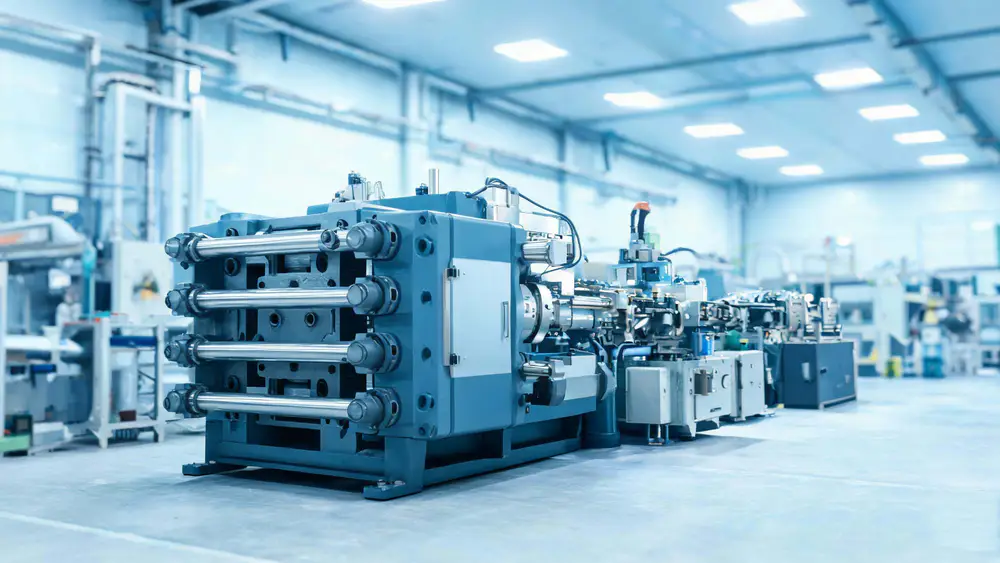
If you are selecting a model for an aluminum alloy project, you can refer to He Xin's Aluminum Alloy Casting Services together with Aluminum Alloy Castings for the Automotive Industry Based on actual production experience, select the most suitable process route.
I. Why Is the Tonnage of a Die-Casting Machine Important? The Cost of Choosing the Wrong Tonnage
The tonnage of a die-casting machine corresponds to the machine'sClamping force (also known as closing force)—The maximum force that the clamping mechanism can apply to lock the parting line between the moving and fixed dies; the unit is typically measured in metric tons (tf) or kilonewtons (kN). This determines whether the die-casting machine can hold your product securely in place.
| Relatively small tonnage | Excessive tonnage |
|---|---|
| The parting line is forced apart by the molten metal, resulting in flash and dimensional deviations. | Excessively high costs for equipment, molds, and energy consumption |
| High-Frequency Impact on Molds and Reduced Service Life | "Using a sledgehammer to crack a nut"—occupying large machinery and wasting production capacity |
| The mold does not close securely, posing a safety hazard. | Thin-walled parts could be made using a small machine, but it wouldn't be cost-effective. |
II. What Is Clamping Force (Mold-Closing Force)?
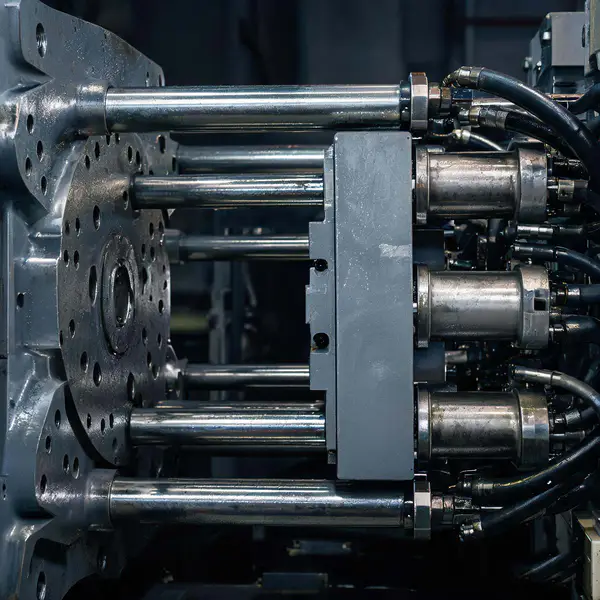
Clamping force is the maximum force that a die-casting machine can apply to clamp the mold parting line. When selecting a die-casting machine based on tonnage, the key consideration isTypical Clamping Force / Rated Clamping Force...rather than treating the limit values on the nameplate as values for everyday use. For safety reasons, the calculated tonnage requirement must be lower than the machine’s rated clamping force and allow for a safety margin.
III. How is the projected area calculated? Both single-chamber and multi-chamber units must be included in the calculation.
Die-casting projected area refers to the area of the casting and its attached structures inArea of the projected contour on the parting line. Many people only consider the weight of the casting itself, which leads to the selection of a die-casting machine with a tonnage that is significantly too small. The following four components must all be included in the calculation:
- Castings: The area of the product's projected outline on the parting line;
- Gating System: Projected area of the main channel and the bypass channel;
- Overflow / Drainage System: Projected area of the overflow channel and the vent channel;
- Material Shank: Projected area of the feed chamber / scrap area.
Total projected area of a single-cavity mold = casting area + runner area + overflow area. For multi-cavity molds, multiply this total by the number of cavities:
Die-casting projected area A = (casting area + runner area + overflow area) × number of cavities
Engineering Practices:When calculating the projected area of a die-cast part, it is recommended to allow for a margin on the area of the filling system. 30%–40% Allowance...covering areas that have not yet been finalized, such as the layout of the runner branches and the overflow channels.
IV. How is the injection pressure ratio determined? Refer to the table based on the alloy type.
Injection pressure refers to the unit pressure (MPa; 1 MPa = 1 N/mm2) exerted by the injection plunger on the molten metal. The higher the injection pressure, the denser the filling; however, this also requires greater clamping force. Injection pressure is primarily determined byAlloy Typerespond in singingQuality Requirements for CastingsCome and pick it up:
| Alloy Type | Recommended Injection Pressure Range (MPa) | Instructions for Use |
|---|---|---|
| zinc alloy | 20 – 40 | For standard structural components, the value is generally around 30. |
| aluminum | 30 – 80 | For general structural components, use 30–50; for airtight components and high-density components, use 60–80. |
| magnesium alloy | 30 – 70 | Thin-walled, lightweight structural components |
| copper alloy | 40 – 80 | High density, high pressure resistance required |
For the same alloy,The thinner the wall thickness, the higher the airtightness requirements, and the higher the injection pressure ratio achieved.; When internal quality requirements are high, the upper limit is typically chosen, but this also results in higher clamping force requirements.
Aluminum alloy castings corresponding to these injection pressure ratios are commonly found in automotive engines. Cylinder Block and Connecting Rod , Gear Housing , as well as in daily necessities and various structural components in the machinery industry
V. How is the safety factor K determined?
The safety factor is used to compensate for fluctuations in clamping force, machining errors in the mold, and deviations in theoretical calculations. Recommended values:
- Standard Structural Components: Take 1.1 – 1.2;
- Air-tight components, high-pressure die-cast parts: Take 1.2 – 1.3.
VI. Formulas for Calculating Die-Casting Machine Tonnage and Unit Conversions
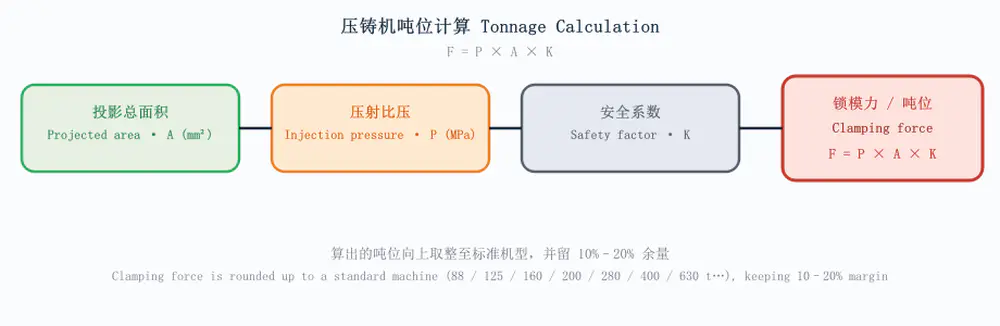
Clamping force F (kN) = Injection pressure P (MPa) × Total projected area A (mm2) × Safety factor K
Since 1 MPa = 1 N/mm2, multiplying these three values directly yields a force in newtons (N), which is then converted to metric tons:
| Unit | Conversion Relationships | instructions |
|---|---|---|
| 1 metric ton-force (tf) | ≈ 10 kN | Commonly used in engineering: 1 tf ≈ 9.8 kN |
| 1 MPa | = 1 N/mm2 | Pressure and area can be multiplied directly. |
After calculating the result,Round up to the next standard tonnage model. Common tonnage ranges for die-casting machines include 88, 125, 160, 200, 280, 400, 630, 800, 1000, 1250, 1600, 2000, 2500, and 3000 metric tons, among others.
VII. Practical Example: Step-by-Step Calculation
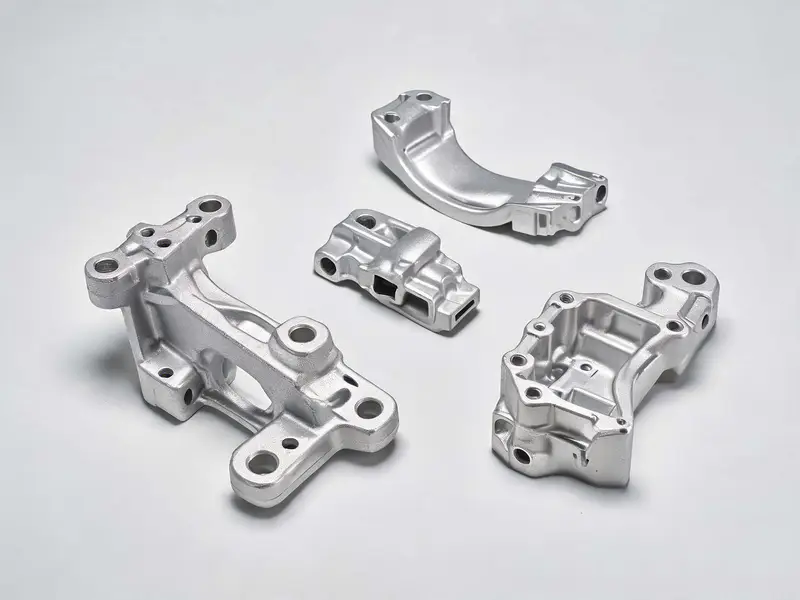
The following examples demonstrate the complete substitution process based on common engineering parameters; for bulk implementation, you can contact He Xin at Aluminum Alloy Casting and Product Manufacturing Services We offer design and pilot production services.
Case Study 1 · Single-Piece Aluminum Alloy Casting
- Projected dimensions of the casting: 200 mm × 150 mm → Area of the casting = 30,000 mm2;
- Based on a 30% allowance for the runner, overflow, and sprue → die-casting projected area A = 30,000 × 1.3 ≈ 39,000 mm2;
- For standard structural components, use a pressure-to-injection ratio of P = 40 MPa;
- Set the safety factor K = 1.2;
- Required clamping force F = 40 × 39,000 × 1.2 = 1,872,000 N ≈ 1,872 kN ≈ 187 metric tons;
- Go up to view standard models → Select 250T / 280T Die-Casting Machines.
Case Study 2 · Four-Cavity Zinc Alloy Casting
- The area of each casting cavity is 100 × 80 = 8,000 mm2; including the 30% gating system for each cavity → 10,400 mm2 per cavity;
- The total area of the four-chamber projection is A = 10,400 × 4 = 41,600 mm2;
- Zinc alloy structural components, with a pressure injection ratio P = 30 MPa;
- Set the safety factor K = 1.2;
- Required clamping force F = 30 × 41,600 × 1.2 = 1,497,600 N ≈ 1,498 kN ≈ 150 metric tons;
- Go up to view standard models → Select 160-metric-ton die-casting machine.
VIII. Avoiding Pitfalls When Selecting Die-Casting Machine Tonnage: 4 Common Misconceptions
- Misconception 1: Counting only the castings and not the gating system → The result is significantly too small. Be sure to include the sprue, overflow, and gate in the die-casting projection area.
- Misconception 2: Using the "maximum clamping force" as a standard value → Select the model based on the typical/rated clamping force and allow for a margin of safety.
- Misconception 3: Omitting the safety factor K → When the theoretical value approaches the upper limit, chipping is highly likely; be sure to factor in a safety margin.
- Misconception 4: Omitting the number of cavities in multi-cavity molds → Calculate the total by multiplying "total area per chamber" by "number of chambers" to avoid calculating based on a single chamber.
IX. Frequently Asked Questions (FAQ) About Die-Casting Machine Tonnage
What is the relationship between the tonnage of a die-casting machine and the weight of a die-cast part?
There is no direct linear relationship. The tonnage required is determined by the projected area and the injection pressure ratio, not by weight. For parts of the same size, the required tonnage differs for aluminum alloys and zinc alloys due to differences in the injection pressure ratio.
What is the maximum projection area for a projector of this weight class?
Derived from the formula: Projected area ≤ rated tonnage ÷ (injection pressure × safety factor K). For example, for a 280-metric-ton machine with 40 MPa and K = 1.2, the projected area is approximately 58,000 mm2; this value must be verified based on the actual mold dimensions of the machine model.
What are the consequences of selecting a die-casting machine with too high a tonnage?
This increases equipment, tooling, and energy costs, and large machines have low utilization rates. We recommend selecting the next size up based on actual needs; there is no need to blindly opt for larger machines.
What are the differences in selecting die-casting machines for aluminum alloys and zinc alloys?
Aluminum die casting requires a higher injection pressure ratio (30–80 MPa), while zinc die casting requires a relatively lower one (20–40 MPa). Due to differences in injection pressure ratio, the tonnage of the die-casting machine required for the same projected area varies significantly.
What should I do if the machine's actual clamping force does not reach the rated value?
The force required to lock the mold is susceptible to plate deformation and wear on the clamping mechanism. It is recommended to allow a margin of 10%–20% based on the rated value and to periodically check the parallelism of the clamping cylinders and mold plates.
X. Conclusion: A Checklist for Selecting the Right Die-Casting Machine Tonnage the First Time
- The total projected area for die casting is calculated as follows: casting + runner + overflow + sprue; for multi-cavity molds, multiply by the number of cavities;
- Refer to the alloy table for the injection pressure ratio; for hermetically sealed and high-density parts, use the upper limit;
- Don't forget to apply a safety factor K (1.1–1.3);
- Round up the calculated tonnage to the next standard model and allow for a margin of 10%–20%.
Before actual production begins, it is recommended to cross-check the specifications using the mold’s 3D data and, if necessary, make a final confirmation based on the clamping force measured by the equipment manufacturer. By thoroughly addressing these three factors—projected area, injection pressure ratio, and safety factor—you can avoid making mistakes when selecting the appropriate die-casting machine tonnage.
This article was compiled by the technical team at Ningbo Hexin Molding Co., Ltd., which specializes in the manufacture of aluminum alloy die-casting molds and products using low-pressure, gravity, and high-pressure casting processes. Please visit our official website to learn more about die-casting processes and our custom project services.