














How to Choose a Casting Process: Low-Pressure Casting vs. Gravity Casting vs. Die Casting vs. Sand Core Casting
Excerpt:
Two castings with similar specifications on the drawings can differ by more than double in yield rate, cost, and service life simply because the wrong process was selected. As an engineer with many years of experience in aluminum alloy casting, I initially relied on experience to make decisions. It wasn’t until I broke down the three variables—wall thickness, performance requirements, and batch size—and compared them individually that I was able to base my process selection on a reproducible, logical framework.
Article Catalog[Hidden]
- 1. Why Does the Choice of Process Determine the Success or Failure of a Casting?
- 2. A Quick Overview of the Definitions of the Four Major Manufacturing Processes
- 3. Core Comparison Table: Wall Thickness / Performance / Batch Size
- 4. Select the manufacturing process based on product requirements
- 5. Pairwise Comparison of Algorithms (Narrow Down Your List of Candidates)
- 6. Mold Costs, Cycle Time, and Time to Market
- 7. Sample Verification and Avoiding Common Defects
- 8. Accumulated Experience in Process Selection (Low-Pressure / Gravity / Die-Casting Integration)
- 9. FAQ
- 10. Conclusion
This article doesn't get into abstract concepts; instead, it uses a singleWall Thickness / Performance / Batch Comparison Table...by considering mechanical properties, airtightness, mold costs, and cycle time, we’ll help you clearly understand the trade-offs between low-pressure casting, gravity casting, die casting, and sand core casting. At the end of the article, you’ll find frequently asked questions and real-world case studies that you can directly apply to your products.
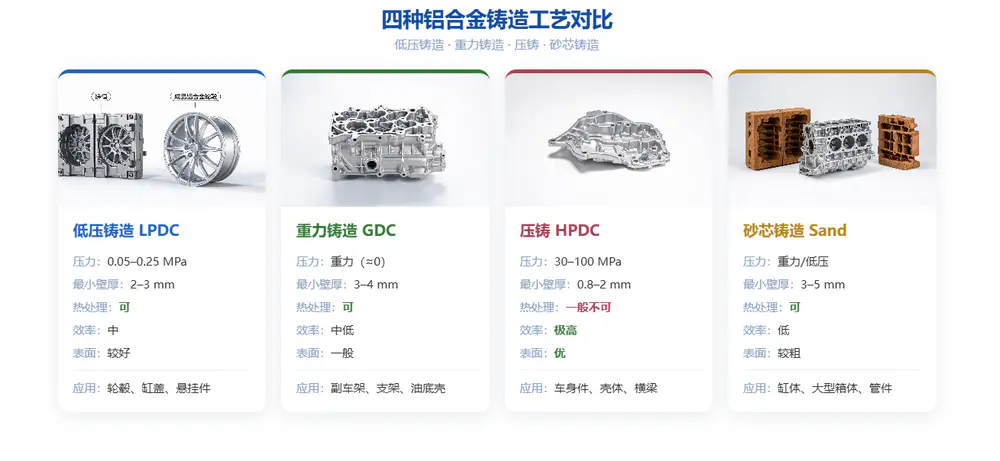
1. Why Does the Choice of Process Determine the Success or Failure of a Casting?
The fundamental differences among the four casting processes lie inRechargeable Powertogether withMold Material (Metal Mold / Sand Mold)...This directly determines how thin the casting can be, how high its performance can be, how low the cost can be, and how large the production volume can be. When selecting a model, you need to answer three progressive questions:
- Wall thickness:What is the range of the product’s nominal wall thickness? Does it meet the minimum castable wall thickness required for this process?
- Performance:Is it under pressure, airtight, or subject to stress? Can you accept the impact of porosity or shrinkage on strength and airtightness?
- Batch:A single prototype, a small batch, or tens of thousands of units per year? Which is the primary consideration—mold amortization or cycle time?
2. A Quick Overview of the Definitions of the Four Major Manufacturing Processes
Low-pressure casting
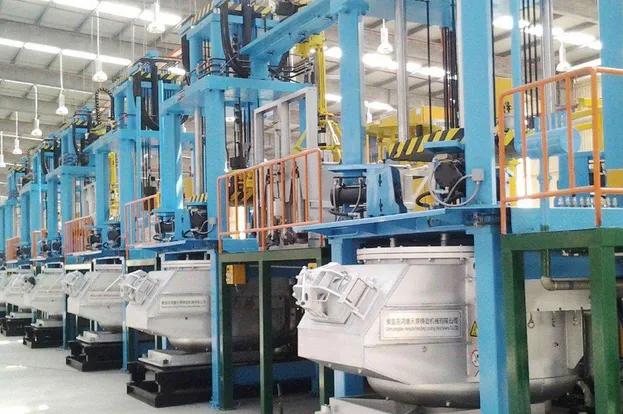
Molten metal is gently filled from the bottom up using low-pressure air, with continuous shrinkage compensation during solidification. The filling speed is controllable and results in minimal entrapped gas, soHigh density, low porosity, and capable of heat treatment hardening(such as T6) is the material of choice for load-bearing and pressure-bearing components. Typical examples include wheel hubs, valve covers, steering knuckles, and transmission housings.
Gravity Casting (Metal Mold Gravity Casting)

Molten metal is poured into a metal mold under its own weight. Compared to sand molds, metal molds offer faster heat transfer, higher dimensional accuracy, and a better surface finish; compared to low-pressure casting, they feature moderate costs, flexible cycle times, and the ability to cast thicker walls. They are a common choice for medium-volume parts such as cylinder blocks, pump housings, and valve bodies.
Die Casting (High-Pressure Die Casting)
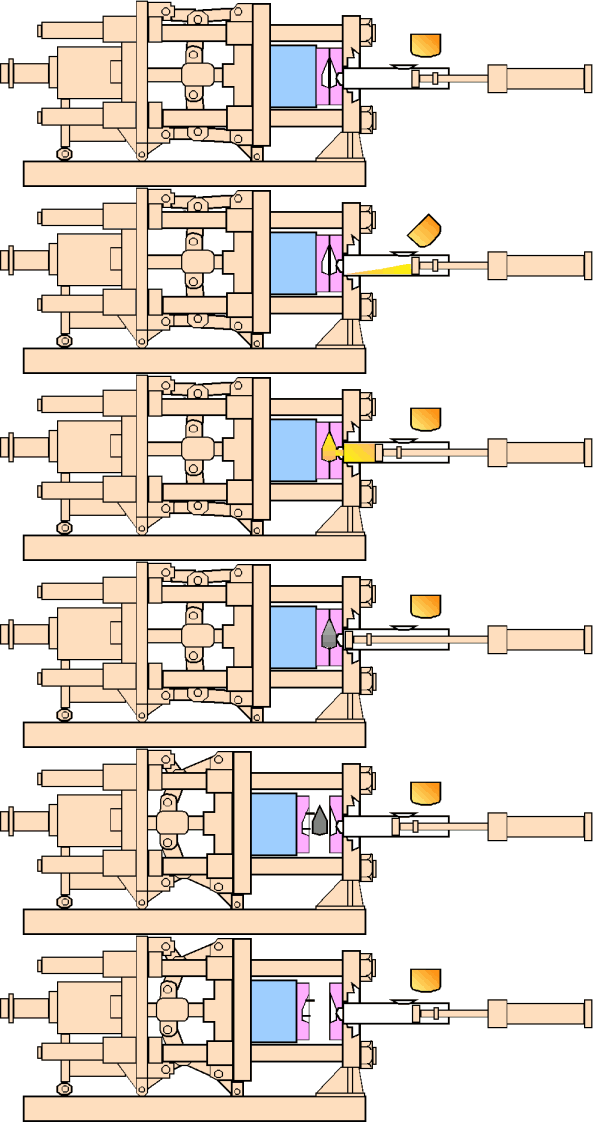
Filling at extremely high pressure and extremely high rates allows for the thinnest wall thicknesses (0.5–2 mm) among the four processes, with the best dimensional accuracy and surface quality, as well as the fastest cycle times. This makes it best suited for high-volume production of thin-walled parts (housings, heat sinks, and fasteners). The trade-off is that the high-speed entrainment of gas in the molten metal can easily causestoma, Exercise caution with airtight, pressure-bearing components.
Sand Core Casting (including sand cores)
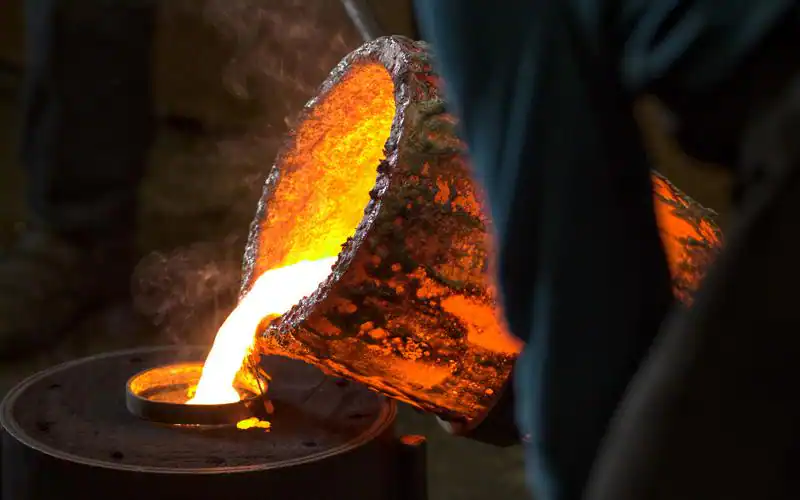
Using sand molds and sand cores as the mold cavity imposes virtually no restrictions on wall thickness or dimensions, allowing for the production of large, ultra-thick-walled parts and complex internal cavities. This method offers low mold costs and the fastest production turnaround. However, precision and surface finish are generally average, requiring post-processing. It is the preferred choice for single-piece prototypes, large parts, and small-batch production.
3. Core Comparison Table: Wall Thickness / Performance / Batch Size
| comparison dimension | Low-pressure casting | Gravitational casting | Die casting | Sand Core Casting |
|---|---|---|---|---|
| Wall Thickness (Typical Range) | 3–8 mm; any thickness is acceptable | Wide range: 4–20 mm | 0.5–2 mm (thinnest) | 5 mm or greater; no restrictions on thick walls |
| Dimensional accuracy | High (close to die-casting) | center | supreme | Low; requires machining |
| surface quality | 好 | rather or relatively good | Best | general |
| mechanical property | Premium (Dense, Heat-Treatable) | Good, stable | Medium (with limited porosity) | Capable of carrying large loads |
| Air-tight / Pressure-resistant | 優 | 良 | General (Pinhole Risk) | Requires post-processing |
| Mold Cost | your (honorific) | center | supreme | Lowest / Even lower with wooden molds |
| Equipment Investment | your (honorific) | center | your (honorific) | lower (one's head) |
| Unit production cost | center | mid-to-high | Low (thin-walled, high-volume) | Low (low efficiency per item) |
| Applicable Batch Size | Medium to Large Quantities | Medium-volume | In large quantities | Single Item / Small Batch |
| Alloy Compatibility | Aluminum, magnesium, etc. | Aluminum, Copper, Cast Iron | Aluminum, Zinc, Magnesium | Comprehensive Coverage for Iron, Steel, Copper, and Aluminum |
| Typical Products | Hubs, cylinder blocks, brackets | Cylinder block, pump housing, valve body | Housing, Heat Sink, Connectors | Machine beds, bases, and large castings |
A 15-Second Mnemonic for Selecting the Right Model:For thin-walled, high-precision, high-volume production → die casting; for dense, pressure-bearing, or load-bearing parts → low-pressure casting; for medium wall thickness and a balance between performance and cost → gravity casting; for single large parts, complex internal cavities, or extremely thick walls → sand core casting.
4. Select the manufacturing process based on product requirements
Classified by Wall Thickness
- Thin-walled (<2 mm) → Die casting: Only high-pressure die casting can reliably fill thin-walled parts.
- Medium to thick (3–20 mm) → Low-Pressure / Gravity Casting: Balancing strength, density, and cost.
- Thick-walled (20 mm+) → Sand Core Casting: Not limited by wall thickness; the inner cavity can be hollowed out with a sand core.
Classified by Performance Requirements
- Pressure-bearing, airtight, and load-bearing components → Low-pressure casting(Dense and heat-treatable) + Gravitational casting(Stable).
- Heat Sink, Housing, Exterior Components → Die casting(Thin walls provide good thermal conductivity + a smooth surface).
- Large Load-Bearing Structural Members → Sand Core Casting.
By Batch
- Single Item / Sample → Sand Core Casting(Rapid production using wooden molds or low-cost molds).
- Medium-volume orders (hundreds to thousands of units) → Gravitational castingBest value for the money.
- Large quantities (tens of thousands or more) → Die casting(Takt time + mold amortization dilution).
Batch size and mold amortization are hidden bottlenecks in product selection: the higher the mold cost, the more it needs to be offset by production volume. To understand the cost thresholds for different batch sizes, please refer to our analysis of The Actual Minimum Order Quantity (MOQ) Threshold for Aluminum Casting A teardown of .
Industry Project Case Studies
| Products | Recommended Processes | Selection Criteria |
|---|---|---|
| Car wheels | Low-pressure casting | Load-bearing and pressure-resistant, dense + T6 heat-treatable |
| Engine Block / Transmission Housing | Gravity / Low-Pressure Casting | Medium-to-thick walls + airtight + consistent performance |
| Housing, Heat Sink, Connectors | Die casting | Thin-walled, high-precision, high-volume |
| Machine tool beds, large bases | Sand Core Casting | Extra-thick walls + complex internal cavities + single-piece |
Automotive components have the most stringent requirements for airtightness, strength, and consistency, and they best demonstrate the value of process selection. You can refer to our practical experience in automotive applications. Guide to Selecting and Purchasing Aluminum Alloy Castings for Automobiles .
5. Pairwise Comparison of Algorithms (Narrow Down Your List of Candidates)
Low-Pressure Casting vs. Die Casting
Both processes use metal molds, but they differ in the filling mechanism. Low-pressure casting produces a smooth, dense finish with superior mechanical properties, making it suitable for pressure-bearing and load-bearing parts; die casting features high-speed filling, thinner wall thicknesses, and faster cycle times, but is prone to porosity. For aluminum alloy parts,Wall Thickness and Airtightness RequirementsUsually, they'll make that choice for you.
Gravity Casting vs. Sand Core Casting
Both rely on gravity, but the key lies in the mold medium. Metal molds (gravity casting) offer high precision, excellent surface finish, and consistent performance, making them suitable for medium-volume production; sand molds (with sand cores) are flexible, inexpensive, and have limited wall thickness, making them suitable for single-piece and large-sized parts. Complex internal cavities can usually only be achieved using sand cores.
Why We Should Take Die-Casting Leakage Issues Seriously
Gases entrapped during high-speed filling in die casting form pinholes after solidification, which directly compromise the leak-tightness of pressure vessels. If a product requires thin walls, high production rates, and airtightness, low-pressure die casting may be considered, or post-processing such as impregnation may be applied to the die-cast parts—the former is more reliable, while the latter is faster but involves an additional process step.
6. Mold Costs, Cycle Time, and Time to Market
- One-time investment:Die-casting molds and equipment have the highest pressure, followed by low-pressure die casting, then gravity casting, with sand cores (especially wooden molds) having the lowest pressure.
- Cost per unit:As production volumes increase, die casting offers the greatest advantages due to its short cycle times and lower mold amortization costs.
- Molding Cycle:Sand core production takes the least time (wooden molds take several days), gravity casting takes about several weeks, and the design of low-pressure and die-casting molds, along with runner simulation, takes the longest.
The mold design directly determines the quality of the castings and the mold’s service life; it warrants a separate project evaluation to gain a deeper understanding. Principles, Structure, and Applications of Aluminum Alloy Molds .
7. Sample Verification and Avoiding Common Defects
- Process Transfer Risks:Prototypes made with sand cores and mass-produced parts made via die casting often cannot be compared in terms of performance and airtightness; therefore, it is essential to produce a prototype using the target manufacturing process before finalizing the design.
- Corresponding Common Defects:Shrinkage (insufficient shrinkage compensation) → Adjust the pouring channel / switch to low-pressure or gravity casting; Porosity (gas entrapment) → Change the mold filling method; Cold shuts / flow marks (insufficient temperature) → Adjust process parameters.
- Air-tight / Load-bearing components:Conduct non-destructive testing (X-ray/ultrasonic) and pressure testing before curing, and draw conclusions based on data rather than intuition.
From drawings to prototypes, both design details and costs are under control—see attached for reference. A Comprehensive Guide to Aluminum Alloy Prototype Casting Services in China ; For detailed quality control guidelines prior to mass production, see Third-Party Inspection Process and Acceptance Criteria for Aluminum Castings .
8. Accumulated Experience in Process Selection (Low-Pressure / Gravity / Die-Casting Integration)
Metal molds and post-processing lines used for low-pressure, gravity, and die-casting processes can be shared. An integrated facility can switch between processes within the same system based on your drawings, reducing losses associated with transferring work between factories. To systematically compare the established applications of each process, please read our article on Applications and Typical Uses of Low-Pressure Casting Compiled by .
Need professional aluminum alloy casting services?
Ningbo Hexin Molding Co., Ltd. — 16 years of experience in aluminum alloy casting, providing one-stop casting production and processing solutions
Contact Us Now →9. FAQ
How do you choose between low-pressure casting and gravity casting?
Load-bearing and pressure-bearing components that require high density, heat treatability, and excellent mechanical properties should be produced primarily by low-pressure die casting; products that are more sensitive to cost and production volume, have relatively thick walls, and have moderate airtightness requirements may be produced by gravity casting.
What is the thinnest wall thickness that can be achieved in die casting?
High-pressure die casting can consistently produce parts as thin as 0.5 to 2 mm—or even thinner—making it the best choice among the four processes for producing the thinnest parts with the best surface finish and dimensional accuracy, and is ideal for high-volume production of thin-walled parts.
What is the difference between sand-core casting and gravity casting?
Sand-core casting uses sand molds and sand cores; it features extremely low mold costs and minimal wall thickness limitations, making it suitable for single-piece or small-batch production, as well as parts with complex internal cavities and large, extra-thick-walled components. Gravity casting uses metal molds, offering greater stability in terms of precision, surface finish, and performance, and is suitable for medium-volume production.
What is the most cost-effective process for small-batch castings?
Sand-core casting is preferred for single pieces or very small quantities, using wooden patterns or low-cost molds for rapid production; when production volumes increase to several hundred pieces, gravity casting offers better overall cost performance.
How should I choose a process for castings that must be airtight and pressure-resistant?
Low-pressure die casting is the preferred method—it offers smooth filling, low porosity, and good density; gravity casting is the next best option; high-pressure die casting carries a risk of pinholes and is not recommended for applications with high airtightness requirements.
10. Conclusion
When selecting a process, there is no "best" option—only the "most suitable" one. Focus onWall Thickness → Performance → Batch SizeFollowing this main approach—first use the comparison chart to narrow down the options to 1 or 2 candidate processes, then make a final decision based on a balance between mold costs and cycle time—will help you avoid most rework and scrap.