














A Complete Guide to Electrocoating: A Comprehensive Analysis from Principles to Applications
Excerpt:
Electrophoretic coating is a coating technology in which paint is deposited in a directed manner onto the surface of a workpiece within an electric field. In the English name, "electro" refers to electroplating, electric, or electrolysis; "phoretic" refers to interatomic conductivity; and "deposition" refers to a deposit or precipitate. In Chinese, it is also known as electrophoretic coating, electrophoretic paint, or electrophoretic lacquer.
Electrophoretic coating is a specialized coating method that uses an applied electric field to cause particles such as pigments and resins suspended in an electrophoretic bath to migrate in a specific direction and deposit on the surface of a substrate near the electrodes. As one of the core technologies in modern industrial coating, electrophoretic coating has been widely adopted in industries such as automotive manufacturing, hardware products, electronics and electrical appliances, construction, shipbuilding, and aerospace, thanks to its significant advantages, including high efficiency, strong adhesion, environmental friendliness, and low energy consumption.
Article Catalog[Hidden]
- I. What Is Electrocoating?
- II. Characteristics and Advantages of Electrophoretic Coating
- III. Limitations of Electrocoating
- IV. The Working Principle of Electrocoating
- V. Electrocoating Process Flow
- VI. Components of Electrocoating Equipment
- VII. Electrocoating Process Parameters
- VIII. Frequently Asked Questions and Solutions
- IX. Applications of Electrocoating
- X. FAQs on Electrocoating
I. What Is Electrocoating?
Definition and Overview
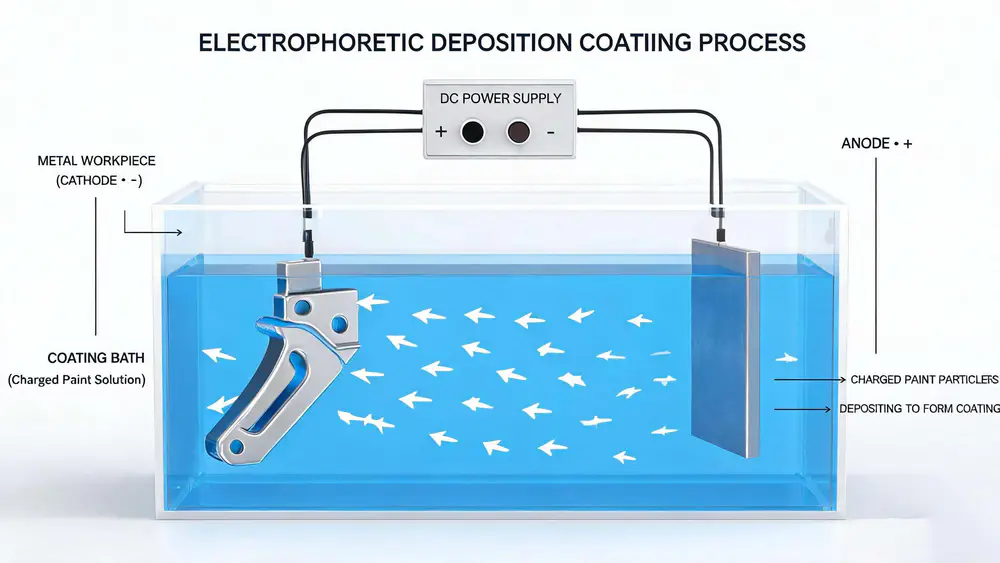
Electrophoretic coating utilizes an applied electric field to cause particles such as pigments and resins suspended in the electrophoretic bath to migrate in a specific direction and deposit on the surface of the substrate at the electrode. During the electrophoretic coating process, under the influence of an electric field, charged particles in the coating solution migrate toward the electrodes and deposit on the surface of the workpiece. By adjusting the electric field strength and the composition of the electrophoretic bath, the coating thickness and properties can be controlled.
Development History
Electrophoretic coating technology has undergone nearly a century of development:
- 1917 — The first patent for electrophoretic painting was granted to David and General Electric.
- the 1920s — This process began to be used for depositing rubber latex.
- the 1930s — The first patents on electrophoretic deposition of water-dispersible resins were published.
- The late 1950s — Ford Motor Company began developing the electrophoretic painting process, and electrophoretic painting began to take on its current form.
- 1963 — The first commercial anodic automotive electrophoresis system has begun operations.
- 1965 — The first patent for cathodic electrophoresis products was published and assigned to BASF.
- 1970 — PPG Industries launches its first commercial cathodic electrocoating product.
- 1975 — Cathodic electrocoating was used for the first time in the automotive industry.
- To date — Approximately 70% of electrophoretic coating worldwide is used in cathodic electrophoresis systems, primarily due to the high adoption rate of this technology in the automotive industry.
II. Characteristics and Advantages of Electrophoretic Coating
?
Low energy consumption
Electrophoretic coating requires relatively little energy and can significantly reduce energy consumption compared to traditional spray coating processes.
??
High Efficiency
It can complete large-area coating in a short amount of time and is suitable for high-volume assembly line operations.
??
High Adhesion
The coating adheres strongly to the substrate and is not prone to peeling. Under the influence of an electric field, it forms a uniform film, significantly improving corrosion resistance in the workpiece’s internal cavities, welds, and edges.
??
Environmental Protection
Use water-based coatings to reduce environmental pollution. Electrocoat paints have low solvent content and offer good production safety.
Detailed Explanation of Core Advantages
- Fully mechanized and automated — Electrophoretic coating can be fully mechanized and automated, which not only reduces the physical strain on workers but also significantly increases labor productivity, making it suitable for large-scale assembly line operations.
- High swimming penetration rate — Electrophoretic coatings have high penetration rates; they dissolve or emulsify completely in water, resulting in bath solutions with very low viscosity that easily penetrate the pocket-like structures and crevices of the coated objects, making them particularly suitable for surface coating of irregularly shaped conductive materials.
- Uniform and fine film formation — The electrophoresis bath solution has high conductivity, allowing coating ions to migrate rapidly under the influence of an electric field. After being neutralized on the surface of the substrate, they form an electrically neutral wet coating film. As the wet coating film thickens, the electrical resistance increases, and the deposition rate of coating particles gradually decreases, resulting in a uniform and fine coating film.
- High paint utilization rate — The paint utilization rate is high, reaching 95% or more, and even 100%. Due to the low solid content and low viscosity of the bath solution, the coated objects carry away very little paint; in particular, the use of ultrafiltration technology enables a closed-loop coating process, resulting in a high paint recovery rate.
- High corrosion resistance — Because electrophoretic coating produces a uniform film under the influence of an electric field, this method significantly improves the corrosion resistance of a workpiece’s internal cavities, welds, and edges.
III. Limitations of Electrocoating
Although electrophoretic coating offers numerous advantages, it also has certain limitations in practical applications that must be taken into account when selecting a process:
- Suitable for conductive substrates — Electrophoresis can only be performed when an electric current is applied; therefore, it is suitable for conductive substrates (typically metals).
- Restrictions on Combinations of Multiple Metals — Substrates composed of multiple metals with different electrical conductivity should not be coated using the electrophoretic coating process, as some electrophoretic coatings may exhibit sensitivity to metal ions such as Cu and Sn.
- Requires baking to cure — The wet film of electrophoretic coatings must be baked to form a dense coating; therefore, the electrophoretic coating process cannot be used on substrates that cannot withstand high temperatures.
- Short tank solution replacement cycle — Since the bottom of the electrophoretic coating tank must be replaced within six months, electrophoretic coating is not suitable for small-batch production.
- Differences in Substrate Properties — The performance of electrophoretic coatings varies depending on the substrate.
- High technical requirements — This requires strong technical support, particularly for color electrophoresis; achieving the desired color effects can be challenging for non-professionals.
IV. The Working Principle of Electrocoating
Electrophoresis is one of the most effective methods for coating metal workpieces. In electrophoretic coating, a conductive workpiece is immersed in a tank filled with a low-concentration, water-diluted electrophoretic coating solution and serves as the anode (or cathode), A corresponding cathode (or anode) is set up in the tank. After applying a direct current between the two electrodes for a period of time, a uniform, dense coating that is insoluble in water is deposited on the surface of the workpiece. This is a specialized coating method.
The electrophoretic coating process involves four types of chemical and physical changes: electrolysis, electrophoresis, electrodeposition, and electroosmosis.
① Electrolysis
The phenomenon in which any conductive liquid decomposes when an electric current is applied is called electrolysis. For example, in an aqueous solution containing a conductive medium, when a direct current is applied, oxygen is produced at the anode and the metal dissolves, while hydrogen is reduced at the cathode and metal is deposited; this phenomenon is called electrolysis.
② Electrophoresis
Under the influence of an electric field, charged colloidal particles migrate toward the electrode with the opposite charge; this phenomenon is called electrophoresis. Charged particles in the coating are driven by electric field forces to move in a specific direction toward the surface of the workpiece.
③ Electrodeposition
In electrophoretic coating, charged particles (resin and pigments/fillers) are drawn by an electric field toward the electrode with the opposite charge, where they are neutralized by H? (anodic electrophoresis) or OH? (cathodic electrophoresis), forming a water-insoluble coating film. This coating film is highly stable, dense, and uniform. This process is known as electrodeposition.
④ Electroosmosis
Electroosmosis is the reverse process of electrophoresis. If the electro-deposited particles adhere to a certain location, they no longer move under the influence of the electric field, and the dispersing medium moves in the opposite direction to their movement within the loose, non-compact particle structure. This electrochemical process causes the solvent to be dialyzed out, thereby strengthening the mechanical bonding of the electro-deposited film.
V. Electrocoating Process Flow
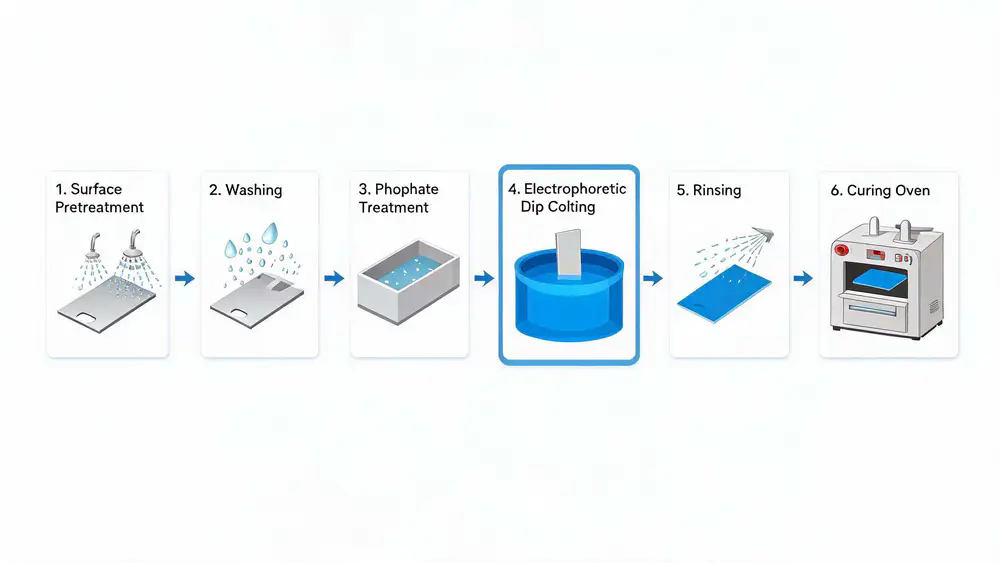
Electrophoretic coating systems can generally be divided into two categories: continuous-flow systems for continuous production and batch-type fixed systems. In continuous-flow electrophoretic coating systems, workpieces are transported via overhead conveyors and integrated with other processes (pretreatment and drying) to form a continuous coating production line; this type of equipment is suitable for high-volume production. For stationary electrophoretic coating equipment used in batch production, workpieces are transported via monorail electric hoists or other types of conveyors and integrated with other processes (pretreatment and drying) to form a batch-type coating production line. This type of equipment is suitable for medium-volume coating production.
Preprocessing
By cleaning the workpiece surface to remove contaminants such as oil and rust, and by performing surface conditioning and phosphating, the adhesion of the coating is enhanced.
Electrophoresis Tank Configuration
Configure the electrophoresis bath solution according to coating requirements, design the electrophoresis tank structure, control the temperature of the electrophoresis bath solution, and ensure its uniform distribution.
Recirculating Filtration
Remove impurities from the electrophoresis buffer using a filter, and use a recirculation pump to circulate the buffer and control the recirculation flow rate.
Electrically Conductive Coating
Apply an electric current to the workpiece using an electrification device, controlling the voltage and coating time to ensure the coating thickness and uniformity.
Trough Circulation
The use of an in-tank recirculation pump, a filter, and temperature control ensures uniform and consistent coating results.
Coating Curing
Control the curing temperature and time, and select the appropriate curing method (thermal curing, UV curing, etc.) to ensure that the coating film cures completely.
Post-processing
Clean off any residual electrophoresis solution and impurities, inspect and touch up the coating quality, and package the items appropriately to prevent damage during storage and transportation.
Advantages of Cathodic Electrocoating
In cathodic electrophoretic coating, the metal is located at the cathode and is less prone to oxidation. Compared to anodic electrophoretic coating, this method offers greater versatility. The use of an ultrafiltration system prevents contamination of the bath solution, simplifies bath maintenance, and results in a coating with superior corrosion resistance. After coating, the parts are cured in a curing oven, which can be either continuous or batch-type. The temperature profile during the curing process has a significant impact on quality. Generally, an oven temperature tracker is used to periodically monitor the temperature profile during the baking process to ensure it meets process requirements.
VI. Components of Electrocoating Equipment
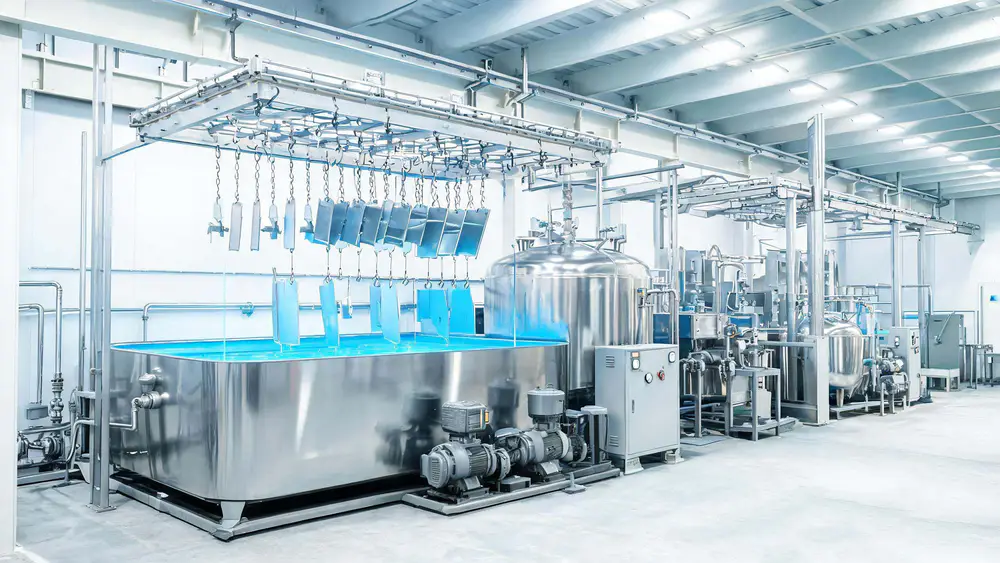
A complete electrophoretic coating system consists of the following core equipment:
| Equipment Name | Feature Description |
|---|---|
| Trough | The main equipment used in electrophoretic coating—whose design and performance parameters determine the efficiency and quality of the coating process. |
| Agitation and Circulation System | The design and performance of the circulation system determine the flow and renewal of the coating, which significantly affect the coating results and uniformity. |
| Electrode Assembly | A core component that provides the electric field driving force, ensuring the oriented deposition of coating particles. |
| Paint Temperature Control Device | Controlling the temperature of the coating environment has a significant impact on the leveling and film-forming properties of the coating. |
| Paint Supply System | Maintain a stable concentration of the electrophoresis solution to ensure consistent coating quality. |
| Ultrafiltration System | Implement a closed-loop coating process to improve paint recovery rates. |
| Ventilation System | Ensure good air quality in the painting area and vent harmful gases. |
| Power Supply Unit | The voltage and current of the power supply determine the driving force behind electrophoretic coating, and their stability has a significant impact on the coating results. |
| Post-Swim Rinse Station | Remove any residual electrophoretic coating and impurities from the surface of the workpiece. |
| Paint Storage System | Store and dispense electrophoretic coatings to ensure a stable supply. |
VII. Electrocoating Process Parameters
Coating Performance Parameters
Viscosity
The viscosity of the coating determines its flowability in an electric field; if the viscosity is too high or too low, it will affect the results of the electrophoretic coating process.
Solid Content
The solids content determines a coating’s hiding power and film thickness, and has a significant impact on the coating’s appearance and performance.
Resistance
The electrical resistance of a coating determines its ability to become charged in an electric field, which has a significant impact on the uniformity and effectiveness of electrophoretic coating.
Coating Ingredients
The components of electrophoretic coatings include resins, pigments, solvents, and additives; the proportions and properties of these components directly affect the physical and chemical properties of the coating.
Coating Environment Parameters
| parameters | Impact Description |
|---|---|
| temp | The temperature of the coating environment has a significant impact on the leveling and film-forming properties of the coating; temperatures that are too high or too low can affect the coating results. |
| Humidity | The humidity in the coating environment has a significant impact on the surface tension of the coating; humidity that is too high or too low can affect the coating results. |
| Cleanliness | The cleanliness of the coating environment determines the level of impurities in the coating and has a significant impact on the uniformity and quality of the coating. |
| stresses | The atmospheric pressure in the coating environment has a slight effect on the surface tension of the coating, and fluctuations in atmospheric pressure can affect the uniformity and quality of the coating. |
In the painting process, factors such as electrophoretic voltage, time, temperature, the anode-to-cathode area ratio, the solids content of the paint, and the pH of the paint all affect the quality of the coating. In actual production, these parameters must be determined based on the customer’s process specifications.
VIII. Frequently Asked Questions and Solutions
Uneven Coating
Uneven coating refers to a situation during the coating process where, due to various reasons, the coating is distributed unevenly on the workpiece surface, resulting in variations in thickness and color. Uneven coating may result from improper control of parameters such as the concentration, temperature, and electric field strength of the electrophoretic bath, or from inadequate surface preparation of the workpiece, as well as coating times that are too long or too short.
Solution:To address the issue of uneven coating, the parameters of the electrophoretic bath—such as concentration, temperature, and electric field strength—can be adjusted to ensure the stability and uniformity of the coating process. At the same time, the pretreatment of the workpiece surface—including rust removal, degreasing, and dust removal—should be enhanced to improve surface adhesion.
The coating is too thin
An under-thick film refers to a coating that is too thin after application, resulting in an inability to achieve the expected protective and decorative effects. An under-thick film may be caused by factors such as insufficient concentration of the electrophoretic bath, insufficient coating time, or excessively low electrophoretic voltage.
Solution:To address the issue of an excessively thin coating, measures such as increasing the concentration of the electrophoretic bath, extending the coating time, or raising the electrophoretic voltage can be taken to increase the coating thickness. At the same time, check the liquid level in the electrophoretic tank to ensure there is sufficient bath solution.
Excessively Thick Coating
Excessive film thickness refers to a situation where the coating thickness exceeds the expected value after application, which may result in problems such as a rough surface or peeling. Excessive film thickness may be caused by factors such as excessive concentration of the electrophoretic bath, excessive coating time, or excessive electrophoretic voltage.
Solution:To address the issue of excessive coating thickness, measures such as reducing the concentration of the electrophoretic bath, shortening the coating time, or lowering the electrophoretic voltage can be taken to reduce the coating thickness. At the same time, improving the pretreatment of the workpiece surface can help prevent excessive deposition.
Coating Peeling
Coating peeling refers to a situation where, after application, the coating has poor adhesion to the workpiece surface and is prone to flaking or peeling. Coating peeling may be caused by improper surface preparation of the workpiece, insufficient pretreatment prior to coating, or improper control of coating process parameters.
Solution:To address the issue of coating peeling, the surface pretreatment of workpieces—such as rust removal, degreasing, and dust removal—can be enhanced to improve surface roughness and adhesion. At the same time, adjust the parameters of the electrophoretic bath—such as concentration, temperature, and electric field strength—to improve the coating’s adhesion. During production, regularly inspect and clean the electrophoretic tanks and circulation pipes to ensure the quality and stability of the electrophoretic bath.
Other Questions
Other issues may include poor stability of the electrophoresis solution, the presence of particles or impurities on the workpiece surface, and uneven color. These issues may be caused by factors such as poor-quality raw materials, equipment malfunctions, or improper operation. To address these issues, a series of measures can be taken, including strengthening quality control of raw materials, conducting regular inspections and maintenance of equipment, and adjusting process parameters. At the same time, quality control and inspection during the production process should be strengthened to promptly identify and resolve issues, thereby ensuring the quality and stability of the final product.
Need professional electrophoretic coating services?
Ningbo Hexin Molding Co., Ltd. — 16 years of experience in aluminum alloy casting, providing one-stop surface treatment solutions
Contact Us Now →IX. Applications of Electrocoating
?? Automotive Manufacturing
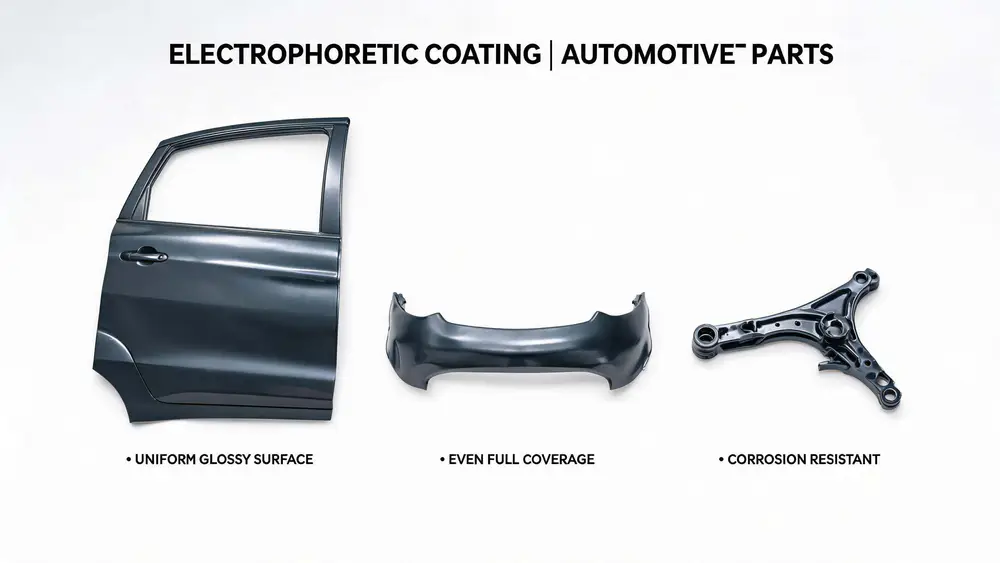
Used for coating automotive bodies and components. Electrophoretic coating of automotive bodies is the most widespread application of electrophoretic coating technology, and cathodic electrophoretic coating production lines for complete vehicles are already widely used in the bus coating industry.
?? Hardware Products
Such as the coating of metal doors and windows, kitchenware, furniture, and other products. Electrophoretic coating can effectively improve the corrosion resistance and appearance of hardware components.
?? Electronics and Electrical Appliances Industry
Used for insulating coatings, conductive coatings, and more. Electrophoretic coating technology for household appliances plays a crucial role in improving the corrosion resistance and aesthetic quality of these products.
??? Other Fields
Such as coating requirements in industries including construction, shipbuilding, and aerospace. In the construction industry, the electrophoretic coating process can improve the durability and aesthetic quality of buildings; in the furniture industry, it can enhance the corrosion resistance and aesthetic quality of products.
X. FAQs on Electrocoating
What is the difference between electrophoretic coating and spray painting?
Electrophoretic coating offers significant advantages over traditional spray painting: paint utilization rates reach 95% or higher (compared to typically only 30–50% for spray painting); the coating is more uniform and can cover the internal cavities and crevices of workpieces; it provides stronger adhesion and superior corrosion resistance; and the use of water-based coatings makes the process more environmentally friendly. However, electrophoretic coating requires a conductive substrate and involves a substantial capital investment in equipment. What is the difference between cathodic and anodic electrophoresis?
In cathodic electrophoretic coating, the metal workpiece acts as the cathode, making it less prone to oxidation and resulting in a more uniform coating with better corrosion protection; in anodic electrophoretic coating, the workpiece acts as the anode, which can lead to metal dissolution. Currently, approximately 70% of electrophoretic coating applications worldwide use the cathodic electrophoresis method, which is most widely used in the automotive industry. What is the typical coating thickness for electrophoretic coating?
The coating thickness in electrophoretic painting typically ranges from 15 to 35 micrometers, and the specific thickness can be adjusted based on process parameters (voltage, time, temperature, solids content of the paint, etc.). By adjusting the electric field strength and the composition of the electrophoretic bath, the coating thickness and properties can be precisely controlled. What materials are suitable for electrophoretic painting?
Electrophoretic coating is suitable for conductive substrates, typically metallic materials such as steel, aluminum alloys, and zinc alloys. Substrates composed of multiple metals with differing electrical properties are not suitable for the electrophoretic coating process. Substrates that cannot withstand high temperatures (curing temperatures) are also not suitable for this process.
summarize
As a highly efficient, environmentally friendly, and high-quality coating technology, electrophoretic coating has established an irreplaceable position in the global manufacturing industry. From automotive bodies to hardware components, and from household appliances to building components, electrophoretic coating provides reliable surface protection for a wide range of metal products thanks to its uniform coating, excellent adhesion, and superior corrosion resistance.
As the manufacturing industry continues to raise its standards for environmental protection and quality, electrophoretic coating technology is also advancing steadily. Ningbo Hexin Molding Co., Ltd. has extensive experience in aluminum alloy casting and surface treatment and is committed to providing customers with high-quality casting and coating solutions. If you would like to learn more about electrophoretic coating or inquire about related services, please feel free to contact us.