













A Comprehensive Guide to Teflon Coating Processes: A Step-by-Step Analysis from Principles to Applications
Excerpt:
Teflon coating is a surface treatment method based on fluoropolymers. It involves uniformly applying PTFE and related fluoropolymers to the surface of metal or other substrates via spraying, followed by high-temperature sintering to form a coating that offers high-temperature resistance, low friction, and excellent chemical stability. It has a wide range of applications and is commonly used in food processing machinery, chemical processing equipment, valve seals, bearings, kitchenware, and corrosion-resistant components.
To truly master the process for this type of coating, one must go beyond the superficial notion of "just spraying it on a few times and calling it a day." Instead, systematic control is required across multiple stages, including material composition, substrate selection, pretreatment, coating methods, sintering conditions, and quality inspection.
Article Catalog[Hidden]
- 1. Material Systems and Coating Structures
- 2. Key Characteristics of Teflon Coating
- 3. Substrate Selection and Pretreatment
- 4. Dispersion Coating Process
- 5. Powder Coating Process
- 6. Key Points of the Spraying Process and Parameters
- 7. Sintering, Film Formation, and Heat Treatment
- 8. Post-Coating Inspection and Performance Evaluation
- 9. Common Issues and Solutions
- 10. Application Scenarios and Key Engineering Considerations
- XI. Frequently Asked Questions (FAQ) About Teflon Coating
1. Material Systems and Coating Structures
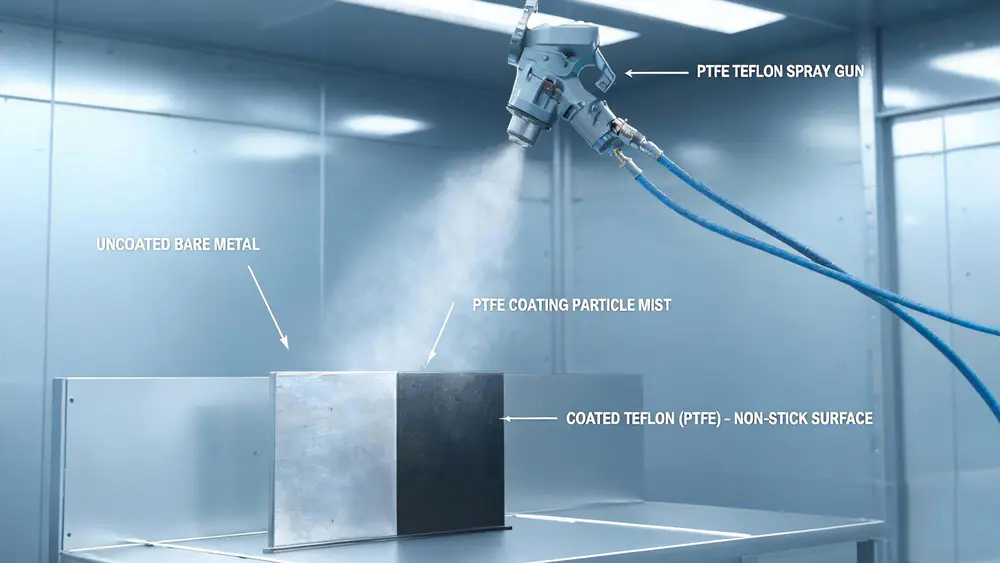
A Teflon coating system generally consists of three parts:Matrix resin, dispersions or binders, and auxiliary additives. Common spray-coating systems are water-based or organic-dispersion systems, in which PTFE particles settle and fuse under high-temperature conditions to form a continuous film. To improve adhesion and coating uniformity, it is often necessary to add a certain amount of binder, low-molecular-weight additives, and film-forming promoters. In some formulations, trace amounts of surface-active agents, such as titanates and silane coupling agents, are also added to improve the interfacial bonding between the substrate and the coating.
Before curing, the coating is often in a dispersed state, and the surface typically requires heating to promote the migration of PTFE particles and form a continuous, dense coating together with the binder. After film formation, the main characteristics of the coating includeExtremely low surface energy, excellent chemical resistance, good high-temperature resistance, and outstanding wear resistance. It is important to emphasize that while PTFE itself has a very high temperature resistance, during the high-temperature sintering stage, the thermal stability of the substrate and the adhesion between the coating and the substrate also determine the final film quality. Therefore, the choice of material must be tailored to the substrate conditions to avoid typical defects such as insufficient adhesion, coating delamination, or cracking.
Types of Teflon Coatings
Teflon high-performance specialty coatings are fluorocarbon coatings based on polytetrafluoroethylene (PTFE). Known in English as “Teflon,” these coatings are also commonly referred to as “Tiefulon,” “Tiefulong,” “Tefulong,” “Tefulong,” and similar names due to pronunciation variations. Teflon coatings are a unique type of high-performance coating that combinesHeat resistance, chemical inertness, excellent insulation stability, and low friction... It offers comprehensive advantages that other coatings cannot match, and its versatility allows it to be applied to products of virtually any shape or size.
| typology | Full Name | Maximum Operating Temperature | Key Features |
|---|---|---|---|
| PTFE | Polytetrafluoroethylene | 260°C continuous, maximum 290–300°C | Extremely low coefficient of friction, good wear resistance, and excellent chemical stability |
| FEP | Fluorinated ethylene-propylene copolymer | 200°C | When baked, it melts and flows to form a pore-free film, offering exceptional chemical stability and excellent non-stick properties. |
| PFA | Perfluoroalkyl compounds | 260°C continuous | Like FEP, it forms a non-porous film when melted; it offers greater rigidity and toughness, making it suitable for applications requiring high-temperature non-stick properties and chemical resistance. |
| ETFE | Ethylene-tetrafluoroethylene copolymer | 150°C continuous | The toughest fluoropolymer, a highly durable coating, and exceptional chemical resistance |
2. Key Characteristics of Teflon Coating
After being coated with Teflon, it exhibits the following six key characteristics:
1. Non-stick properties
Virtually all substances do not adhere to a Teflon coating. Even very thin coatings exhibit excellent non-stick properties.
2. Heat Resistance
Excellent heat and cold resistance. It can withstand temperatures up to 300°C for short periods and is generally suitable for continuous use between 240°C and 260°C. It exhibits remarkable thermal stability, remains flexible at freezing temperatures without becoming brittle, and does not melt at high temperatures.
3. Slipperiness
Low coefficient of friction (0.04–0.15). The coefficient of friction changes as the load slides, but the values fluctuate only within a very narrow range.
4. Moisture Resistance
The surface repels water and oil, and does not easily become contaminated with solutions during production operations; if a small amount of dirt adheres to it, it can be easily wiped away. Downtime is minimal, which saves labor hours and improves work efficiency.
5. Wear Resistance
It exhibits excellent wear resistance under high loads. Under certain loads, it offers the dual advantages of wear resistance and non-stick properties.
6. Corrosion Resistance
It is virtually impervious to chemical attack and protects parts from all types of chemical corrosion.
3. Substrate Selection and Pretreatment
The substrate has a direct impact on the quality of the coating film. Metallic substrates such as aluminum, steel, copper, and their alloys are common substrates for PTFE spraying. Aluminum is widely used due to its high specific strength, light weight, and good thermal conductivity; however, its surface is prone to oxidation, so strict pretreatment is required to ensure coating adhesion. Common pretreatment steps include:
- Cleaning and Degreasing:Use an alkaline or neutral cleaning agent at a temperature of 60°C to 80°C to remove surface oils and contaminants, then rinse thoroughly with pure water to prevent cleaning residues from affecting coating adhesion.
- Surface Roughening:Surface roughness is increased through mechanical grinding, sandblasting, or acid etching to enhance the mechanical interlock of the coating. For aluminum, the target surface roughness is in the range of approximately 0.6–1.2 micrometers (Ra) to achieve good adhesion strength and coating uniformity.
- Surface Activation and Primer Treatment:In certain systems, a primer coat or surface activator is required to enhance adhesion. Primers are often formulated as hybrid organic-inorganic systems, which provide the necessary interface transition layer prior to sintering and improve the bond strength between the coating and the substrate.
- Drying and Preheating:Before spraying, minimize moisture and water content on the substrate surface; if necessary, preheat at a low temperature to reduce thermal stress and improve coating uniformity.
4. Dispersion Coating Process
Overview
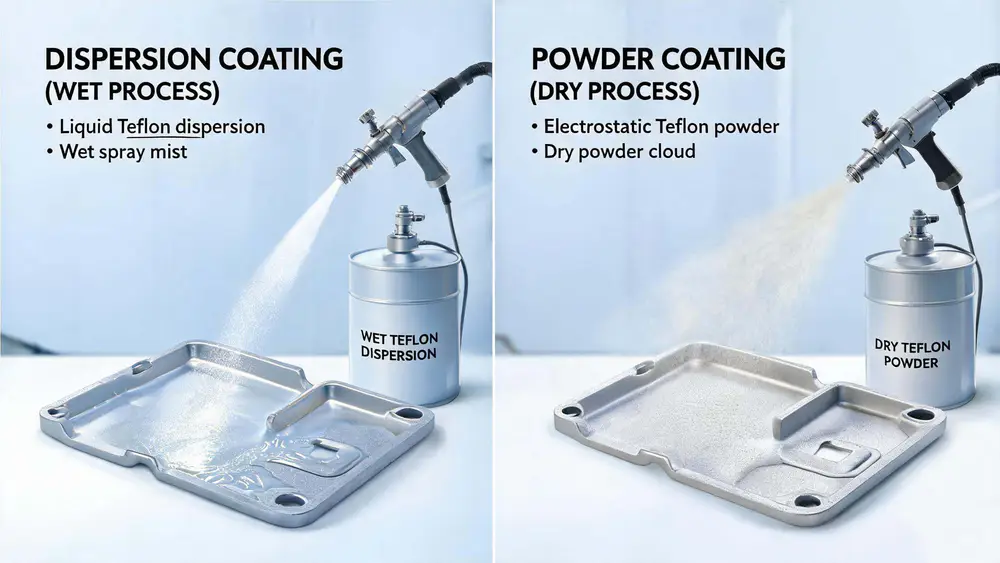
The process for applying a dispersion coating is a wet process in which the coating material is uniformly distributed in a solvent to form a dispersion (a solid substance suspended in a liquid). This mixture is atomized using high-pressure air and sprayed onto the surface of the workpiece.
Processing Steps
- Preparation of the Workpiece:To ensure sufficient surface adhesion on the workpiece, all grease must first be removed from the surface to be coated. We use an organic solvent to dissolve the grease and heat it to approximately 400°C to ensure complete evaporation. Next, the workpiece is mechanically cleaned using sandblasting to roughen its surface. The adhesion between the coating and the workpiece surface can be improved by applying an adhesion promoter (primer).
- (Wet) Dispersion Coating Spraying:The sprayed coating material must be uniform and consistent. The coating thickness depends on the coating system used; it can range from a few micrometers to 200 micrometers (0.2 millimeters).
- Drying:Heat the wet coating in a drying oven, maintaining the temperature below 100°C, until most of the solvent has evaporated.
- Sintering:The sintering process involves heating the workpiece to a high temperature until an irreversible reaction occurs: the coating material melts and forms a network structure with the bonding agent.
5. Powder Coating Process
Overview
The powder coating process is a dry process in which the coating material is in the form of extremely fine solid particles. This coating method eliminates the need for solvents and prevents the flaring that occurs during subsequent coating adhesion. The process employs appropriate techniques to ensure that the fine powder coating particles adhere to the workpiece. Subsequently, the applied powder is fused in a curing oven.
Coating Process
- Preparation of the Workpiece:To ensure sufficient surface adhesion on the workpiece, all grease must first be removed from the surface to be coated. We use an organic solvent to dissolve the grease and heat it to approximately 400°C to ensure complete evaporation. Next, the workpiece is mechanically cleaned using sandblasting to roughen its surface. The adhesion between the coating and the workpiece surface can be improved by applying an adhesion promoter (primer).
- Powder Coating:The powdered particles are blown out of the collector by compressed air; along their path to the spray gun nozzle, there is a region where they become electrically charged. Because the particles carry the same charge, they repel one another as they travel, forming a uniform, cloud-like spray. The workpiece to be coated is grounded, thereby creating an electrostatic field between the spray gun and the workpiece. The powder particles are attracted to the workpiece and adhere to its surface.
- Melting of Powder:In coating technology, there are fundamental differences between high-temperature spraying and low-temperature spraying. In high-temperature spraying, the substrate temperature must be higher than the melting point of the powder material, and the powder particles are deposited onto the substrate. In this process, the fine powder melts during spraying. In low-temperature spraying, however, the substrate temperature is lower than the melting point of the powder material. The powder is then melted in a curing oven.
6. Key Points of the Spraying Process and Parameters
Spray coating is the process of delivering a dispersion of coating material to the substrate surface in the form of a mist; the spray parameters directly determine the uniformity of the coating, its thickness distribution, and the stability of the subsequent sintering process. Common spray coating methods includeAir Spraying and High-Pressure Electrostatic SprayingBoth methods have their own advantages and disadvantages. Air spray equipment is simple in design and low in cost, making it suitable for coating small to medium-sized areas; electrostatic spraying can effectively improve material utilization and coating uniformity, making it particularly suitable for complex contours and large-area coating. Regardless of the method used, the following principles should be followed:
- Spray Coating Thickness Control:The dry film thickness of a single coat is typically controlled between 10 and 20 μm, with multiple coats applied to achieve a total thickness of 40 to 80 μm. If the coating is too thin, it may lack sufficient wear resistance; if it is too thick, it may crack or peel.
- Spray Distance and Angle:The distance between the spray nozzle and the substrate is typically between 200 and 400 mm, and the angle should be kept constant to avoid stress concentrations caused by excessively concentrated coating thickness or localized thick spots.
- Suspension Conditions and Curing Conditions:The coating should be in a stable state before spraying to prevent separation or settling. After spraying, the coating should enter the sintering stage within the specified time to prevent problems such as pinholes and particle agglomeration caused by uneven drying of the coating surface.
- Air Pressure and Atomization Control:Air pressure should be maintained within a stable range to ensure an appropriate atomization particle size and achieve a coating with a uniform particle size distribution. For high-viscosity systems, the atomization conditions and feed rate must be adjusted to prevent sagging or pinholes.
7. Sintering, Film Formation, and Heat Treatment
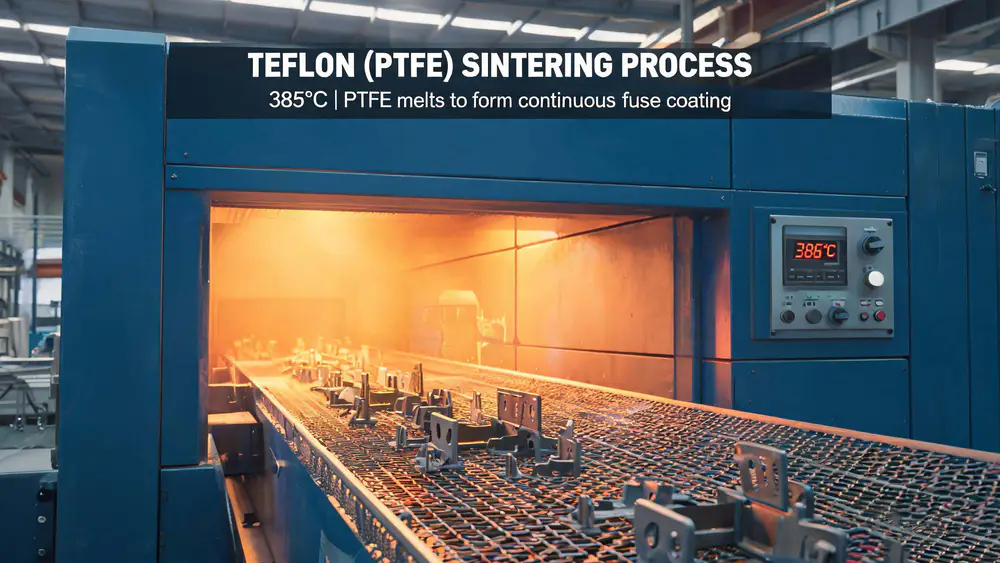
After spraying, the coating must undergo high-temperature sintering to fuse the PTFE particles together, forming a continuous, dense film.Sintering temperature and time are key factors that determine coating performance., which is typically suitable for metal substrates at temperatures ranging from 360°C to 420°C, depending on the coating formulation, coating thickness, and the substrate’s heat resistance. Common process steps include:
- Pre-launch Phase:Gradually heat the coating to approximately 300°C to prevent cracking of the coating surface or excessive interfacial stress caused by sudden temperature increases. This stage promotes uniform drying of the coating and reduces the formation of bubbles.
- Period of Persistent High Temperatures:Maintain a temperature of 380°C to 400°C for 15 to 30 minutes. This stage is critical for the melting of PTFE particles and the rearrangement of molecular chains; only when sufficient bonding and densification are achieved during this stage will the coating exhibit good non-stick properties and chemical resistance.
- Cooling and Annealing:After sintering, cool the sample slowly to prevent thermal stress and coating cracking caused by rapid cooling. The annealing temperature and cooling rate must be matched to the thermal expansion coefficient of the coating system to avoid cracking, peeling, or excessive release of internal stress.
It is important to note that the sintering process places high demands on the substrate’s heat resistance. While aluminum may withstand high temperatures well, extreme temperatures can cause deformation or interface failure if the substrate has localized weak areas. Therefore, during the process design phase, temperature control strategies should be developed for different substrates, such as zone-specific heat treatment and stepwise heating.
8. Post-Coating Inspection and Performance Evaluation
After the coating has been formed, evaluating its performance is key to ensuring repeatability and stability. Several key metrics include:
- Adhesion and Peel Resistance:Good adhesion is achieved within an acceptable range using shear, cross-cut, or scratch adhesion test methods (such as the commonly used cross-cut test). Ideally, the coating should achieve a high rating in routine testing, demonstrating excellent interfacial bond strength.
- Temperature Resistance:Under specified temperature cycling or continuous high-temperature exposure conditions, the coating should maintain its structural integrity without significant peeling or cracking. The continuous operating temperature is typically 260°C or lower; however, certain specialized formulations can withstand short-term exposure to temperatures above 300°C.
- Chemical Stability:It resists attack by a variety of acids, alkalis, solvents, and corrosive media, and the coating surface remains smooth, maintaining a non-stick surface.
- Friction and Non-Adhesion:A low coefficient of friction and a non-stick surface are the most important functional characteristics of PTFE coatings. In standard friction tests, the coefficient typically remains stable within the range of 0.04 to 0.15, with specific values varying depending on the formulation and substrate.
- Surface Flatness and Defects:Visually inspect and examine the coated surface under a microscope to rule out defects such as pinholes, particle agglomeration, and cracks. For components with strict requirements, the coated surface is typically expected to have very few defects.
9. Common Issues and Solutions
| concern | rationale | Solutions |
|---|---|---|
| Pinholes and Bubbles | Uneven paint dispersion, insufficient ventilation, or unstable spray temperature | Optimize coating dispersion, improve the cleanliness of the spraying environment, refine the airflow design, adjust the spraying distance and speed, and ensure thorough drying before sintering. |
| Delamination and Interface Failure | Inadequate pretreatment of the substrate, insufficient primer coating, and thermal stress during the heat treatment process | Enhance surface cleaning, improve the primer formulation, and optimize the sintering profile to ensure the stability of the interfacial transition layer |
| Color and Uniformity | Poor material dispersion or unstable spraying parameters | Maintain coating stability, periodically check the atomization condition, and use layered application to achieve uniform thickness |
| Cracks in Areas of Excessive Thickness | Single-Pass Thick-Film Deposition | A layered coating process is used, with the thickness of each layer strictly controlled; where necessary, localized reinforcement is applied to high-stress areas or a low-stress formulation is used. |
A structured quality inspection process should coverIncoming inspection of raw materials, coating storage and mixing, records of the spraying process, records of sintering conditions, testing of physicochemical properties after film formation, and on-site evaluation of the final components in application. Consistency is ensured through random sampling and comparison of the entire batch. Safety and environmental management are equally important: the spraying and sintering processes require effective ventilation and temperature control systems to prevent the buildup of harmful gases, and waste liquids, gases, and residues must be disposed of in compliance with regulations.
10. Application Scenarios and Key Engineering Considerations
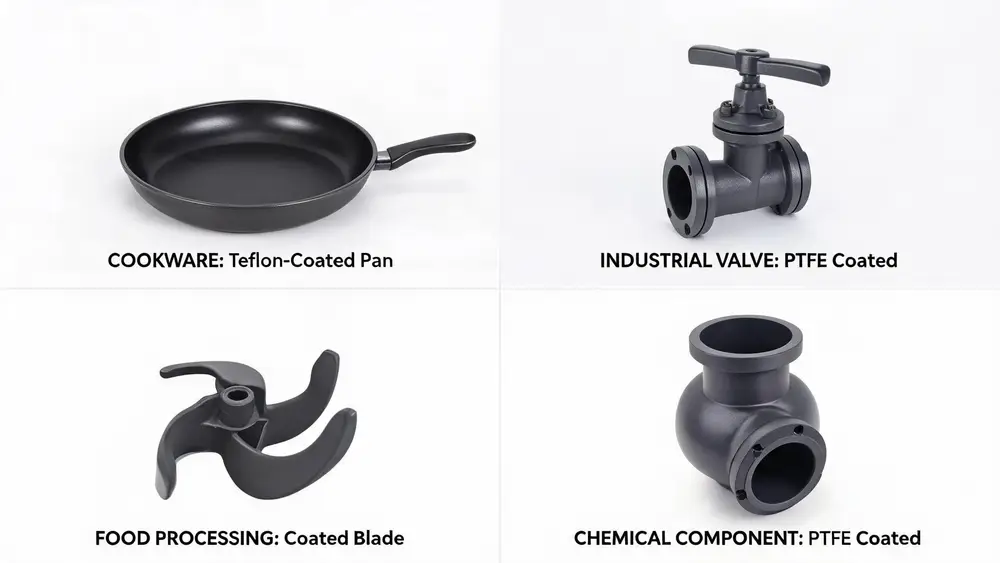
Teflon coatings are widely used in applications requiring low friction and easy cleaning due to their excellent chemical resistance and extremely low surface energy. Teflon is widely used in industries that require high-temperature resistance and high adhesion.
Food Processing Equipment
Guide components, conveyor belts, molds, and other parts require food-contact surfaces that are non-stick and easy to clean.
Chemical Processing Equipment
Sealing surfaces of corrosion-resistant valves, agitator bearing assemblies in chemical reactors, etc.
Cooking Utensils
You'll need non-stick, easy-to-clean cookware, such as non-stick pans, baking sheets, and the like.
Industrial components
Parts such as valve seals, bearings, and corrosion-resistant components that are designed to operate in harsh environments.
In engineering practice, the selection of coating thickness often requires consideration of factors such as temperature fluctuations in the operating environment, the properties of the medium, mechanical loads, and cleaning frequency. For high-temperature environments or highly corrosive media, formulations with higher heat resistance should be selected and combined with appropriate surface preparation to ensure long-term stability.
Need professional Teflon coating services?
Ningbo Hexin Molding Co., Ltd. — 16 years of experience in aluminum alloy casting, providing one-stop surface treatment solutions
Contact Us Now →XI. Frequently Asked Questions (FAQ) About Teflon Coating
What is the difference between Teflon coating and regular nonstick coating?
Compared to ordinary nonstick coatings, Teflon (PTFE) coatings offer higher heat resistance (up to 260°C for continuous use), greater chemical stability (virtually impervious to any chemicals), and a lower coefficient of friction. Teflon coatings are formed into a dense film through a high-temperature sintering process, resulting in stronger adhesion and a longer service life. What is the typical thickness of a Teflon spray coating?
The thickness of Teflon spray coatings ranges from a few micrometers to 200 micrometers (0.2 millimeters), depending on the coating system used and the process requirements. Typically, the dry film thickness of a single spray application is controlled between 10 and 20 μm, and multiple layers are applied to achieve a total thickness of 40 to 80 μm. Is Teflon coating safe? Can it be used for food-grade applications?
Teflon coatings are chemically inert and remain highly stable under normal operating temperatures (below 260°C), releasing no harmful substances. Food-grade Teflon coatings comply with relevant food safety standards, such as those set by the FDA, and are widely used in applications that come into direct contact with food, such as nonstick cookware and food processing equipment. What materials can be used for Teflon coating?
Metal substrates such as aluminum, steel, copper, and their alloys are common substrates for PTFE spraying. Aluminum is widely used due to its high specific strength, light weight, and good thermal conductivity. Different substrates have different requirements for pretreatment and sintering, necessitating the development of tailored process parameters.
summarize
The core of the Teflon spraying process lies in two key objectives: "stability" and “consistency.” The process is systematized—from substrate preparation, formulation selection, coating methods, and sintering control to final inspection—forming a closed-loop process in which even the slightest deviation at any stage can have a significant impact on the quality of the resulting film. Regional Differentiation—Different substrates (aluminum, steel, copper, and their alloys) have varying requirements for pretreatment and sintering, necessitating the development of tailored process parameters. Only when parameters at every stage are strictly controlled, clear boundaries are established, and operators possess the necessary experience and ability to follow procedures can the coating fully demonstrate its comprehensive advantages—non-stick properties, heat resistance, chemical resistance, and low friction—during daily use, thereby truly achieving the goal of extending equipment lifespan and improving operational efficiency through the coating process.