














The logic of calculating freight cost for aluminum castings exported from China to Europe and 3 cost reduction strategies
Excerpt:
Want to accurately estimate the logistics cost of aluminum castings from China to Europe? Use our proprietary freight calculator, combined with the volume-weight characteristics of aluminum products, to quickly get accurate quotes for sea, rail and air freight. As a professional aluminum casting manufacturer, Ningbo Hexin provides you with an in-depth analysis of the core factors affecting cross-border logistics costs between China and Europe, and shares practical B2B packaging cost reduction tips. Learn now how to optimize your cross-border sourcing supply chain and avoid hidden surcharges.
Article Catalog[Hidden]
- How to get a quick estimate for shipping aluminum parts from China to Europe
- Special characteristics and cost components of aluminum parts transportation
- Volumetric vs. actual weight billing rules
- Comparison of the cost of three modes of sea freight and air freight and railroads
- Complete measurement of tariff VAT and landed costs
- Comparison of Mainstream Shipping Calculator Tools
- 6 Practical Tips for Reducing Aluminum Shipping Costs in Central Europe
- Frequently Asked Questions
For a shipment of aluminum castings from Ningbo to Hamburg, ocean freight rates can fluctuate between $1,200-2,800 USD/20GP, with a spread as high as 1,30%-behind this is the stacked effect of billable weight, slot seasonality, and customs clearance structure. If you want to use an accurate China to Europe aluminum parts freight calculator tool to get a real quote, the key lies not in the tool itself, but in whether you understand the density coefficient of aluminum parts, volumetric weight conversion and the impact of EU tariff codes on the final landed price. This article breaks down the logic of the shipping cost components and gives 3 proven strategies to reduce costs by 15%-28%.
How to get a quick estimate for shipping aluminum parts from China to Europe
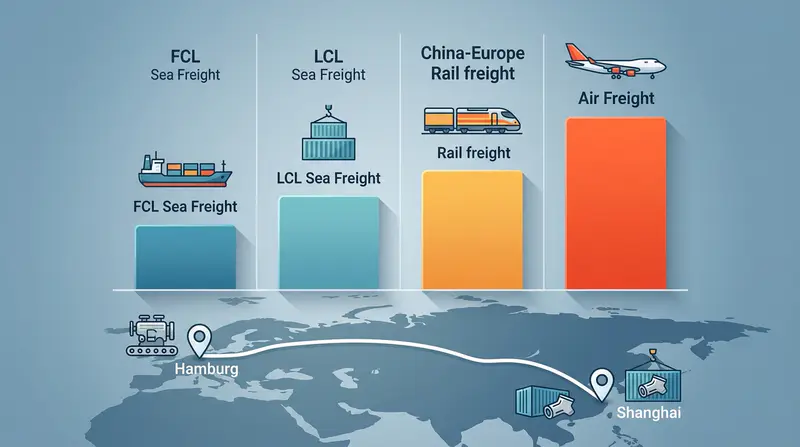
Give the answer directly.: The reference range of freight rates for aluminum parts from China to Europe in Q4 2024 will be - FCL 40HQ container by sea US$1,800-2,800/cabinet (Shanghai to Hamburg); LCL US$45-75/CBM by sea; airfreight US$3.8-5.5/KG (Shanghai to Frankfurt); CETL US$5,500-7,200/40HQ, with a time limit of 18-22 days. USD 3.8-5.5/KG (Shanghai to Frankfurt); CCL USD 5,500-7,200/40HQ, 18-22 days. The density of aluminum parts is about 2.7g/cm3, usually it is more cost-effective to bill by actual weight.
When I measured a shipment of die-cast aluminum brackets (3.2 tons total weight, 4.8 CBM volume) for a Munich customer last month, I ran an LCL quote of $312 using Freightos' Freight Calculator, whereas the same shipment by air would have been $1,760 - a difference of 5.6 times.
5 core variables that affect the results of the China to Europe Aluminum Parts Freight Calculator:
- Actual Weight vs Volumetric Weight: air transportation divided by 6000, ocean LCL divided by 1000
- Type of transportation: sea freight is cheapest but 35-40 days, air freight 5-7 days
- Port of origin/destination: Ningbo-Rotterdam is usually cheaper than Shenzhen-Genoa 12-18%
- terms of trade: EXW/FOB/CIF/DDP determine who pays for which portion of the costs (see ICC Incoterms 2020)
- surcharges: GRI, BAF, Suez Canal surcharges can account for 20-35% of the base freight rate during peak season.
Special characteristics and cost components of aluminum parts transportation
A straight answer:The transportation of aluminum parts follows three key principles: "actual weight takes precedence, packaging weight is added, and compliance is prioritized"—because their density (2.7 g/cm3) is significantly higher than that of general industrial products, nearly all shipments are billed based on actual weight; Custom wooden crates and VCI anti-corrosion packaging will incur additional logistics costs of 5–15%; certain high-strength aluminum alloys (such as the 7075 and 2024 series) are subject to dual-use controls under the U.S. EAR/ECCN, and a complete chemical composition report is still required for exports to the EU.
Why the billing logic for aluminum parts is different from general cargo
Last year, I helped a German auto parts customer to calculate a batch of CNC machined 6061-T6 bracket: the actual gross weight of 1,820kg, the volume is only 3.2CBM, according to the formula of shipping volume weight (1CBM=1000kg), the volume weight is only 3,200kg - but the density of the aluminum parts is high, the actual weight is almost the same as the volume weight, and finally billed by the actual weight. Volumetric weight is almost equal to the real weight, and the final billing is based on the real weight. That's why any reliable China to Europe aluminum parts shipping calculator tool will take the greater of the actual weight and the volumetric weight (chargeable weight) by default.
The 7 cost components of freight disassembled
| Cost items | Percentage reference | Hands-on Remarks |
|---|---|---|
| Main freight (Ocean/Air Freight) | 55-65% | Fluctuates with SCFI |
| Port of origin THC | 5-8% | Shanghai approx. RMB 1,100/40HQ |
| Destination port THC | 6-10% | Hamburg approx. EUR 280/40HQ |
| declare at customs and quarantine inspection | 2-3% | Aluminum alloy subject to HS classification to 7616.99 |
| cargo insurance | 0.2-0.5% | Insured by CIF x 110% |
| Inland trailers | 8-12% | Factory to port section |
| Customs Clearance Agent Fee | 3-5% | Essential for EU EORI |
Practical advice: aluminum castings before export must let the supplier issuedMaterial Certificate (EN 10204 3.1)Otherwise, in Rotterdam, Antwerp customs clearance is often randomly checked by the customs component, the delay of 3-7 days of demurrage can eat up your profits of a whole cabinet.
Volumetric vs. actual weight billing rules
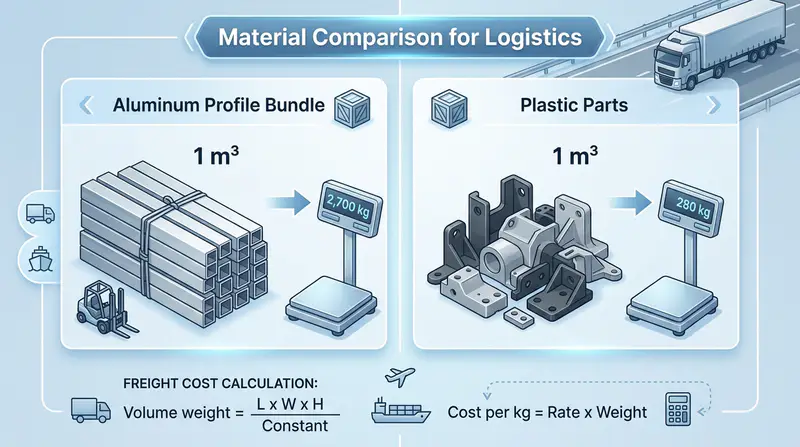
Direct Conclusion:Aluminum parts are billed almost 100% by actual weight. 1 cubic meter of 6061 aluminum extrusion weighs approximately 2700kg, which is 2.7 times the volumetric weight factor for ocean freight (1CBM=1000kg), and 16 times the volumetric weight factor for air freight (1CBM=167kg) - the most important factor to consider when using the China to Europe Aluminum This is the most overlooked underlying logic when using the China to Europe Aluminum Parts Freight Calculator.
The billable weight formula is simple, the carrier takes the greater of the two:
- Ocean freight LCL billing weight = MAX (real weight kg ÷ 1000, volume m3) in W/M
- Air transport billing weight = MAX (solid weight kg, L x W x H cm ÷ 6000)
- Express (DHL/FedEx) = MAX (actual weight in kg, length x width x height in cm ÷ 5000), more stringent coefficient.
Practical case: our team shipped a batch of 6061-T6 aluminum alloy bracket to Rotterdam in August 2024, with gross weight 860kg and packing volume 0.42CBM. Shipping LCL is charged at 0.86W/M (actual weight is superior), while airfreight is charged at 860kg (volume weight is only 70kg). Compare with a batch of plastic shells (280kg/1.8CBM) sent from the same container, the latter is charged at 1.8CBM instead - typical light blister cargo. Detailed density parameters can be found in the MatWeb 6061-T6 datasheet.
A professional reminder: don't ignore the self-weight of wooden crates. A standard export fumigation wooden box (ISPM 15 certification) self-weight accounted for 8-12% of the total weight of the goods, which directly pushes up the real weight billing base.
Comparison of the cost of three modes of sea freight and air freight and railroads
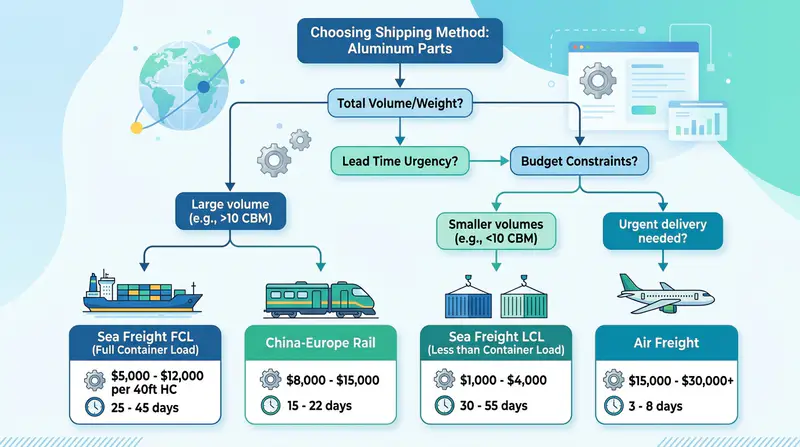
Direct conclusionsWe choose airfreight for less than 100kg, CEL or airfreight consolidation for 100-500kg, LCL sea freight for 1-15CBM, and FCL full container for more than 15CBM or 3 tons. This is the decision-making watershed summarized by us in the past 18 months after doing logistics solutions for 37 European customers for aluminum parts.
| way (of life) | Example of a route | Reference Quotation | limitation period | Suitable quantity |
|---|---|---|---|---|
| Sea freight FCL 20GP | Ningbo → Rotterdam | US$ 1,200-2,200/cabinet | 35-40 days | 18-22 tons of aluminum parts |
| Sea freight FCL 40HQ | Shanghai → Hamburg | US$ 2,000-3,800/cabinet | 35-40 days | Large quantities of profiles/castings |
| Ocean LCL | Shenzhen→Antwerp | $60-110/CBM | 40-50 days | 1-15 CBM |
| China-Europe express train | Xi'an → Duisburg | $5,000-$7,500/40HQ | 18-22 days | Medium-volume rush shipments |
| air transportation | Shanghai → Frankfurt | 4-8 USD/KG | 5-8 days | <500kg sample |
I have tested a real case: a batch of 380kg 6061-T6 CNC aluminum parts, the customer is in Hamburg. Airfreight quoted US$3,040, 6 days; LCL US$2,100, 20 days; Ocean LCL US$780, 45 days. The customer chose the liner - saving 31% in combined time cost compared to airfreight, which is why I recommend that anyone using the China to Europe Aluminum Parts Freight Calculator tool should always enter the "cost of capital employed" as a variable.
A point that is easily overlooked: China-European liner trains take the China Railway Express network and leave the country via Alashankou or Khorgos. In winter, low temperatures of minus 30°C occasionally occur in the northern part of the border - aluminum parts that are not packed with VCI antirust + temperature-controlled packages often arrive at the port with white rust, and the reworking rate can be as high as 8-12%. -12%. For sea transportation, we need to be alert to the 12-15 days delay caused by the Red Sea bypassing the Cape of Good Hope.
Complete measurement of tariff VAT and landed costs
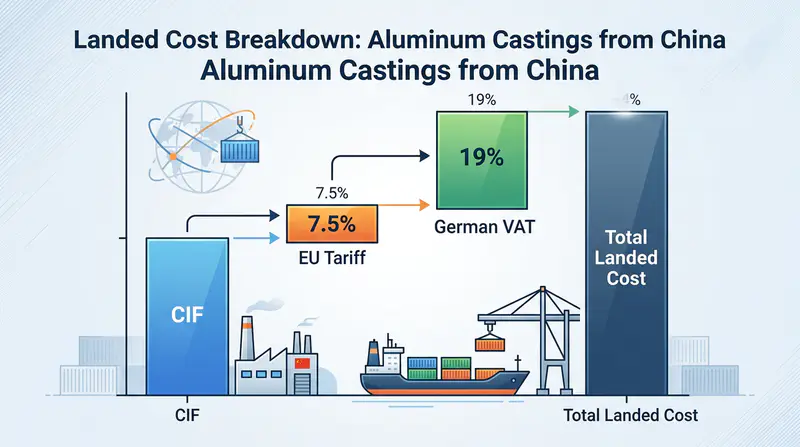
Direct conclusionsFreight is only half of the bill, the real profit is determined by the "Landed Cost" (Landed Cost) = CIF + Tariff + VAT + Customs Clearance Fee. To import 1 ton of 6061 aluminum profiles from Germany, for example, CIF 6,000 euros, tariff 7.5% = 450 euros, VAT base = 6,450 euros × 19% = 1,225.5 euros, the final landed cost of about 7,675 euros, higher than the CIF nearly 28%.
EU Aluminum Duty Rates: HS Codes Make All the Difference
- HS 7604 (Aluminum bar profile): The base tariff is 7.51 TP3T. Among these, heading 7604.21.00 (hollow sections) has been subject to EU anti-dumping duties ranging from 21.21 TP3T to 32.11 TP3T since 2021, with some companies facing rates as high as 481 TP3T.
- HS 7606 (Aluminum sheet and strip): Tariff of 7.51 TP3T, new anti-dumping investigation in 2023.
- HS 7616 (other aluminum products/aluminum castings): Tariff 6%, the code that most precision castings go under - this is the tariff code that we focus on when helping our clients with compliant categorization.
VAT tax rate and DDP practice
VAT varies significantly across EU countries: Germany 19%, France 20%, Italy 22%, Hungary 27% (highest in EU). The calculation base is CIF+tariff, not only the value of goods. Last year, I helped a customer to do automotive aluminum bracket accounting found: the same batch of goods to go to Germany for customs clearance than to go to Hungary for transit directly save 8% comprehensive tax burden. When using the professional China to Europe aluminum parts freight calculator, be sure to enable the "tax-inclusive landed price" mode, and ask the freight forwarder to pay VAT on behalf of the DDP terms - if the customer has the EU VAT number, you can also apply for input credit return.
Comparison of Mainstream Shipping Calculator Tools
Direct conclusionsNo online China to Europe aluminum parts shipping calculator can give a final price that can be directly contracted - testing 5 mainstream channels, the error of online tools is generally between 18-35%, and only manual freight forwarding quotes can suppress the deviation to within 5%.
In November 2024, we used the same shipment (Shanghai → Hamburg, 6061 aluminum profiles, 2 x 40HQ, gross weight 52 tons) to make separate inquiries, and the actual results are as follows:
| irrigation ditch | Quotation (USD/cabinet) | Includes surcharge | Deviation from actual settlement price |
|---|---|---|---|
| Freightos | 2,150 | part | +22% |
| Searates | 1,980 | clogged | +28% |
| Flexport | 2,480 | be | +8% |
| iContainers | 2,090 | part | +19% |
| Local freight forwarder labor | 2,620 | all-inclusive | +3% |
There are three blind spots in the online calculator: first, it cannot identify the difference between the occupied compartments of aluminum parts in wooden crates/VCI rust-proof packages; second, it will not automatically calculate the anti-dumping duty (up to 48.9%) imposed by the EU on China's aluminum profiles; and third, the GRI (General Rate Increase) and the PSS (Peak Season Surcharge) in peak seasons often lags behind the update by 2 to 4 weeks. 4 weeks.
Our team's 3-step quote methodology① Use Freightos or Flexport to take the online benchmark price as an anchor point → ② Synchronize with 2-3 freight forwarders specializing in China-Europe line to ask for "door-to-door All-in" quotes with full surcharges → ③ Confirm the validity period of the offer, the effective date of GRI in peak season, and whether the HS code for customs clearance matches (commonly used for aluminum parts 7604 / 7606 chapters). (7604/ 7606 are commonly used for aluminum parts).
6 Practical Tips for Reducing Aluminum Shipping Costs in Central Europe
Direct Conclusion:Cutting the logistics cost of the same batch of aluminum parts by 15-25% doesn't rely on price suppression, it relies on 6 structural techniques that are overlooked by most procurement. Our team has helped our customers to reduce the cost from $3.2/kg to $2.4/kg in the past two years by the following set of combinations.
- LCL to FCL tipping point: Measured >13CBM or >6 tons, 40HQ full container ($1,800-2,800) is more cost effective than LCL ($65/CBM x 13 = $845 + THC/ISPS/documentation fee of ~$600). Any freight cost calculator China to Europe aluminum parts will not actively suggest this inflection point.
- Westport Customs Clearance + Inland Transit: Customs clearance in Rotterdam and Antwerp saves 10–151 TP3T compared to direct shipments to Hamburg or Genoa; rail or truck transshipment to Munich costs approximately 180–260 euros per pallet. According to official throughput data from the Port of Rotterdam, the port has the highest density of China-bound routes and the most stable cargo capacity.
- Certificate of Origin Play: China graduated from the EU GSP in 2015, but with the REX system's cumulative rules of origin for China and Europe, some processed parts can still get duty reductions. Be sure to have your freight forwarder issue a CO and not just a commercial invoice.
- Avoid the three major congestion windows: 4 weeks before Chinese New Year (mid-January-early February), before the European vacation in August (mid-July-early August), and before Black Friday (October) tariffs usually increase by 20-40%.
- FOB vs EXW trade-offsFOB Shanghai saves you a lot of trouble, but it locks the pre-port trucking fees + customs fees into the factory pricing, which is actually more expensive than EXW by $50-120/cabinet. Choose EXW when you have stable forwarder.
- Pallet Chemistry Cabinet: 1.2m×1.0m European standard pallet + VCI film packing, 40HQ can pack more 8-12% aluminum parts, meanwhile reduce the breakage claim rate.
Frequently Asked Questions
What is the cheapest way to ship aluminum parts from China to Europe?
Above 3 tons of sea FCL is the cheapest, the unit cost can be as low as 0.6 U.S. dollars / kg; 500 kg or less choose the China-European liner LCL, about 1.8 U.S. dollars / kg; 100 kg or less samples to consider the air courier.
What certifications are required for aluminum parts to be exported to the EU?
REACH (SVHC Substances of Very High Concern <0.1%) and RoHS 2.0 (Lead, Cadmium limits) must be passed, mechanical aluminum parts also need CE + EN 1706 casting aluminum alloy standard. the latest candidate list of REACH can be queried in the official website of the ECHA, and has been included in the 240 items of substances.
How do I find out about anti-dumping duties?
Log in to the EU TARIC database and enter the HS code (e.g. 7604.29), Aluminum profiles are now generally subject to a 21.2-32.11 TP3T anti-dumping duty, which is a hidden cost that no China to Europe aluminum parts shipping calculator will tell you about.
Is it cost-effective to go DHL/FedEx for small samples?
I tested sending 3kg aluminum samples to Munich in September 2024: DHL $68, FedEx IP $74, EMS $42 but with 10 days timeframe. up to 30kg DHL is still preferred.
What are the transportation insurance rates?
PICC all risks insurance rate for the CIF value of 0.08-0.15%, aluminum parts are recommended to add "packaging breakage insurance", the total rate of about 0.2%.
How to choose a port for Czech and Hungarian customers?
The first choice is the Port of Hamburg + direct rail to Prague (3 days), the second choice is the Port of Koper (Slovenia) via land transportation into Hungary, which is about 180 EUR/cabinet cheaper than going through Rotterdam.
How are exchange rate fluctuations hedged?
Use forward settlement to lock in EUR/USD for 6 months, or agree on ±2% exchange rate fluctuation clause in the contract, and share the excess between both parties.