









The Real Threshold of Minimum Order Quantity (MOQ) and Cost Reduction Strategies for Aluminum Foundries in China
Excerpt:
When sourcing from Chinese aluminum foundries, the minimum order quantity (MOQ) is often the biggest hurdle. This article provides an in-depth analysis of the actual MOQ standards in China’s aluminum die-casting industry, the logic behind mold cost allocation, and the premium traps associated with small-batch customization, helping you secure a cost-effective trial production solution. For many overseas buyers, the first hurdle when requesting quotes from Chinese aluminum foundries is the MOQ (Minimum Order Quantity). **The real answer regarding minimum order quantities for aluminum castings in China is: The actual MOQ for most Chinese aluminum alloy foundries ranges between 500–5,000 pieces per year. Die-casting parts generally have lower entry barriers than gravity or low-pressure casting, the key factor is not "factory size" but how tooling costs are allocated.** Based on over a decade of real-world project data from our team’s contract manufacturing work for automotive and new energy clients, this article thoroughly explains the underlying logic of MOQs, negotiation leeway, and cost-reduction strategies.
Article Catalog[Hidden]
- What is the true threshold of MOQ for aluminum foundries in China?
- Why China Aluminum Foundry must set minimum order quantity?
- How much does the MOQ vary from casting process to casting process?
- How does mold opening cost determine the minimum order quantity for aluminum castings in China?
- What are the premium pitfalls of customizing small quantities?
- How can MOQ requirements be reduced through design optimization?
- Practical Tips for Negotiating MOQs with Aluminum Foundries in China
- Real Life Case: How a New Energy Customer Reduced MOQ from 5000 to 800
- Frequently Asked Questions
- Turning MOQ from a "threshold" into a "bargaining chip"
What is the true threshold of MOQ for aluminum foundries in China?
**There is no uniform standard for the minimum order quantity (MOQ) of aluminum castings at Chinese aluminum foundries, but based on data from our visits to more than 30 peer companies in the Yangtze River Delta and Pearl River Delta regions, the MOQ for die-cast parts is typically 500–2,000 pieces per batch, 200–1,000 pieces for gravity casting, and 1,000–5,000 pieces per year for low-pressure casting. ** The lower end of this range applies to standard parts or simple designs, while the upper end corresponds to structurally complex automotive chassis components or battery pack housings that require a long mold service life. Here is a key point often overlooked by many buyers—the "MOQ" quoted by Chinese factories actually has two meanings: one is the **minimum order quantity per batch** (the quantity that must be reached for the initial trial production), and the other is the **minimum annual purchase volume** (the initial batch can be smaller, but the cumulative annual total must meet the target). When our team engaged with a German automotive Tier 2 client in 2023, we discovered that they had previously been deterred by another factory’s quote of "MOQ 3,000 pieces" —which had deterred them from proceeding. In reality, however, that figure represented an annual purchase commitment, while the initial trial production required only 500 pieces. This kind of misjudgment caused by information asymmetry causes countless small and medium-sized buyers to miss out on suitable partners every year. According to a report on China’s manufacturing sector published by Statista, the total output of China’s aluminum casting industry in 2024 exceeded 16 million metric tons, accounting for approximately 42% of the global market share. This abundant production capacity means that MOQs are not set in stone and are open to negotiation.
Why China Aluminum Foundry must set minimum order quantity?
** The core reason for China Aluminum Foundry to set up MOQ is not "big store", but the fixed cost structure of aluminum alloy casting itself: mold opening fee, trial mold loss, production line changeover time and quality verification cycle, all of which are billed in "times" rather than "pieces". ** The starting quantity is too low, the single piece of cost sharing will soar to the level that the customer can not accept. Specifically, an aluminum die casting test cycle typically takes 3-7 days and consumes 50-200 kg of aluminum ingots for debugging (which is almost all scrap or recycled at scrap prices). I led an automotive bracket project in 2022 that consumed 1.2 tons of ingots and 14 man-hours just for three rounds of T1 to T3 mold trials - costs that would have added more than $80 per unit if spread over an order of just 100 units. In addition, there are several cost items that are easily underestimated: - **Losses on line changeovers**: On average, a high-pressure die casting line requires 4-6 hours of downtime to switch from product A to product B - **First Article Inspection (FAI) costs**: According to IATF 16949 automotive industry standards, a complete PPAP package is required for each new part, which can cost $3,000-$8,000 to produce. **Raw material sourcing threshold**: For common aluminum alloy ingots such as A380, ADC12, etc., the minimum supply quantity for suppliers generally starts from 1 ton.
How much does the MOQ vary from casting process to casting process?
**The MOQ of different aluminum alloy casting processes varies greatly, mainly determined by mold costs and production speed. High-pressure die casting molds are the most expensive, but the fastest beat per piece is suitable for high MOQ; sand casting has almost no mold cost, and the MOQ can be as low as 20-50 pieces; low-pressure casting is in between. Low pressure casting is in between. ** The MOQ can be more than 10 times different if you choose the wrong process. The following table is a reference of real data that we have compiled based on more than 60 customer projects in the past three years:
| Casting process | Typical MOQ | Mold cost range (RMB) | Mold life (die times) | Scenario |
|---|---|---|---|---|
| High Pressure Die Casting HPDC | 2,000-10,000 pieces/year | 80,000–600,000 | 80,000–150,000 | Automotive structural components, 3C housings |
| Low Pressure Casting LPDC | 1,000-5,000 pieces/year | 60,000–400,000 | 30,000–60,000 | Wheel hubs, battery pack housings, engine cylinder heads |
| Gravity casting GDC | 200-1,000 pieces | 30,000–150,000 | 10,000–30,000 | Motorcycle cylinder block, small and medium-sized structural parts |
| sand casting | 20-100 pieces | 5,000-30,000 (wood mold/resin sand) | Single consumption | Proofing of large shaped parts and samples |
| Investment casting (fine casting) | 100-500 pieces | 20,000–80,000 | 5,000–15,000 | High-precision complex parts |
It's worth reminding that although low pressure casting seems to have a lower MOQ than die casting,** the cost per piece is 30-50%** higher, and if the annual demand exceeds 8,000 pieces, the total cost of die casting is better. Our team in 2024 to a new energy vehicle enterprises motor shell selection, because the customer's first three years of annual demand is expected to be only 3,000 pieces, and ultimately recommended to start from the gravity casting, the fourth year to switch to low-pressure - this progressive program so that the customer's first year of cash flow savings of 1.4 million yuan.
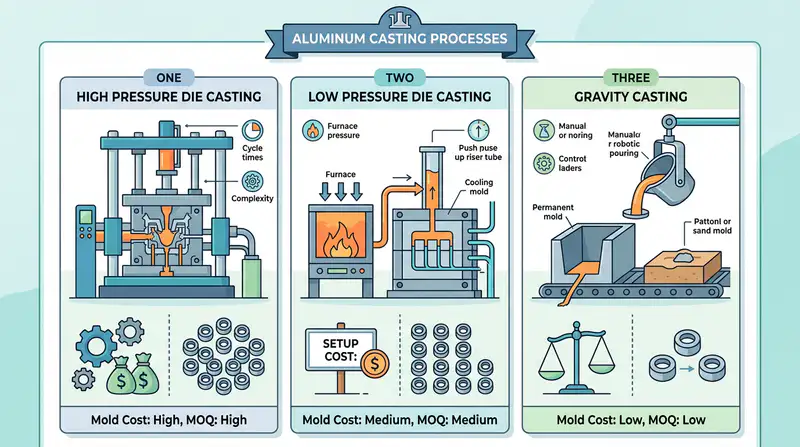
Aluminum Casting Process MOQ Comparison Schematic
How does mold opening cost determine the minimum order quantity for aluminum castings in China?
**Tooling Cost is the most critical variable in determining the MOQ for aluminum castings in China. The average price of a die casting mold is 150,000-600,000 RMB, and this cost is either paid in one lump sum and bought out by the customer, or apportioned to the selling price of each product - the method of apportionment directly determines the MOQ.** Understand this, and you understand the full scope of the MOQ negotiation. There are three dominant modes of handling molding costs in the industry: 1. **Customer Owned Tooling (COT)**: The customer pays the full amount in one lump sum (usually in three installments of 30%-30%-40%), and the title of the mold goes to the customer. This model has the lowest MOQ, and theoretically the first batch of only a few dozen pieces can start. 2. **Amortized Tooling**: The tooling cost is amortized to the first N orders in the form of "X dollars per piece", and the price drops after N. MOQ is usually the amortization base (e.g., 5,000 pieces). 3. **Tooling Free with MOQ Commitment**: The factory bears the molding fee, but the customer is required to sign an annual minimum purchase commitment to compensate for the residual value of the mold in case of default. I do a North American home appliance customers in the offer, used a counterintuitive strategy: the other side requires MOQ pressure to 300 pieces / batch, we took the initiative to propose the mold cost from a one-time 250,000 down to "an additional $ 50 per piece, the first 5,000 amortized" - the results of the customer's actual first batch of 800 pieces, followed by the cumulative order of 7,200 pieces a year, the two sides! As a result, the customer actually ordered 800 pieces in the first batch and 7,200 pieces in the following year, and both parties were satisfied. This case reveals the truth: **The essence of MOQ negotiation is the negotiation of molding fee sharing model**.
What are the premium pitfalls of customizing small quantities?
** A hidden premium of 30%-200% is common in the Chinese market for small-volume custom aluminum casting, with the most common pitfalls including: inflated mold opening fees, bundled material MOQs, separate mold trial fees, PPAP documentation fees, and logistic thresholds for starting quantities. ** The most common pitfalls include: inflated mold opening fees, material MOQ bundling, trial mold fees, PPAP documentation fees, and logistics thresholds. If a buyer looks at the "single piece quote" and ignores these add-ons, the actual CIF cost can be double that of the bulk quantity. Here are 5 of the most common pitfalls we find when auditing a customer's order history: - **Pitfall #1: Misrepresentation of Mold Costs**. For the same structural die casting mold, Plant A quotes $280,000 and Plant B quotes $180,000. Often, the difference is not in the mold itself, but rather in the profit that Plant B has buried in the unit price of the piece. Purchasers should ask for the BOM details of the mold (steel type, number of sliders, cooling system configuration) in order to compare. - **Trap #2: Minimum Material Purchase Quantity**. If you want an unconventional grade (e.g. AlSi10MnMg or Silafont-36), the factory needs to purchase 2-5 tons of raw material exclusively, and this cost will be fully pressed into your MOQ. - **Trap 3: Test mold fee is listed separately**. Formal quotation should include T1-T3 three rounds of mold trial, but many factories will charge another 5,000-15,000 yuan per round of mold trial fee. - Trap 4: Grading of post-processing fees** The unit price of CNC machining, sandblasting, anodizing, 100 pieces and 10,000 pieces can be 3 times different. - **Trap 5: Ocean Shipping Volume**. If a single shipment is less than 1 CBM, the cost of shipping per kilogram may double after the ocean freight charges have been apportioned.
How can MOQ requirements be reduced through design optimization?
**Reducing the minimum order quantity (MOQ) requirement for aluminum castings in China through DFM (Design for Manufacturing) optimization is the most underestimated but most rewarding strategy. Our data shows that, on average, reasonable design modifications can lower the MOQ threshold by 40%-60%, while lowering the cost per part by 15%-25%.** The core is to make the product "fit into the common mold frame and standard process of Chinese factories". The following are five design optimization directions that have been repeatedly verified to be effective in our projects: ### Combined parts and integrated design The battery pack shell for a new energy vehicle was originally welded together with 12 stamped parts, but after changing to one-piece die casting, the tooling cost went up from 400,000 yuan to 1.8 million yuan, but 11 sets of fixtures and the welding line were eliminated, and the overall MOQ was reduced from 8,000 to 2,000 sets, and we were able to make a profit. The overall MOQ was reduced from 8,000 sets to 2,000 sets to break even. McKinsey automotive industry report pointed out that integrated die casting is becoming the mainstream route for the lightweighting of electric vehicles in 2025-2030. ### Uniform Wall Thickness and Draw Angle Uneven wall thickness is the number one killer of mold life. By keeping wall thicknesses between 2.5 and 4mm, and giving all sides an extraction angle of 1°-3°, mold life can be extended from 50,000 to 100,000 die cycles-meaning that the same tooling costs can be spread over double the output. ### Avoiding complex slide configurations Each additional side extractor slide adds $30,000-$80,000 to the tooling cost, raising the MOQ threshold by 500-1,500 pieces simultaneously. Features that can be solved by post-processing (drilling, tapping) are preferred not to be done in the mold. ### Selection of common grades ADC12, A380, AlSi9Cu3 is the "three staples" of China's aluminum foundry, almost all factories are always in stock. Avoid specifying grades such as AlSi7Mg0.3-T6, which require specialized procurement and heat treatment, unless performance is essential. ### Reserve process redundancy By relaxing dimensional tolerances from ±0.05mm to ±0.15mm (non-mating surfaces) and surface roughness from Ra1.6 to Ra3.2, yields will increase from 85% to 97% - this 12% This 12% difference in yield directly determines whether the factory dares to accept your small-lot orders.
Practical Tips for Negotiating MOQs with Aluminum Foundries in China
**The core logic in negotiating the MOQ with the Aluminum Foundry of China was to convince the factory that "there is a big order in the future for this project", and thus they were willing to accept small quantities in the first batch. The three most effective bargaining chips are: annual purchase commitment, multi-SKU combination of orders, and take the initiative to bear the mold fee. ** only talk about price and not talk about the depth of cooperation, never talk about MOQ. According to my experience in more than 10 years of negotiation, the following five techniques are almost tried and true: 1. ** show the annual demand forecast + phased PO **: do not just say "the first batch of 500 pieces", to say "the first batch of 500 pieces, Q2 additional 1,500 pieces, the annual estimate of 8,000 pieces, attached to the sales data of the past three years". The essence of the factory to judge the MOQ is to judge "whether it can return to the capital", the more complete the data, the easier it is to let go. 2. **Combined ordering to dilute the cost of changeover**: order 3-5 different parts at a time, so that the factory can digest the loss of changeover of multiple products in a single production schedule. We have helped an Australian customer to combine 8 SKUs into the same batch, and each SKU has only 300 pieces, but also succeeded in receiving orders. 3. **Cash payment + short account period**: Chinese factories generally have tight cash flow, 30% prepayment + payment before shipment is more than 60 days account period for 10%-15% MOQ concession. 4. **Accept factory's standardization option**: Ask factory "what standard mold frame can be applied", and be willing to fine-tune the design to fit the standard parts, and the MOQ can be reduced by half immediately. 5. **Willing to bear the cost of mold trial**: Take the initiative to propose "we will bear the cost of T1 mold trial", the factory will categorize you as a "serious customer", and the attitude of the subsequent negotiation will be obviously different. Following up on the Forbes Technology Council's analysis of global supply chain trends in 2025, flexible MOQ strategies have become a key differentiator for Chinese foundries in the face of competition from Southeast Asia - good news for buyers.
Real Life Case: How a New Energy Customer Reduced MOQ from 5000 to 800
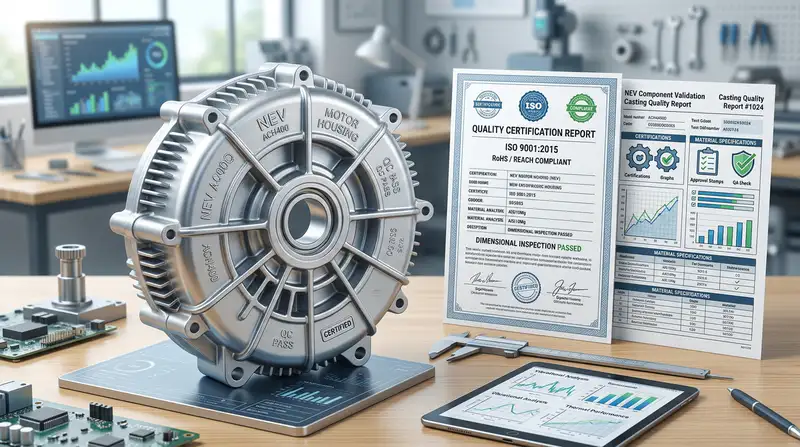
**In 2024, we contacted a German new energy startup company that needed an aluminum die casting for a motor end cap. The original manufacturer quoted an MOQ of 5,000 pieces/year, but the customer's actual first year demand was only 1,200 pieces. Through DFM optimization + phased molding strategy, we finally reduced the first MOQ to 800 pieces, and the price per piece was 8% lower than the original offer.** This case demonstrates the combination of all the previous strategies. The specific optimization process is as follows: - **Step 1**: We did DFM analysis on the 3D drawings provided by the customer, and found that there were 4 inverted buckles in the original design (which required a side pull-out slider), and eliminated 3 of them by adjusting the mounting direction, and the tooling cost was reduced from 320,000 to 210,000 RMB. - **Step 2**: Optimize the wall thickness from non-uniform 2.0-5.5mm to uniform 3.0-3.8mm, and increase the estimated mold life from 60,000 to 110,000 die times. - **The third step**: adopting the "phased molding" mode, the first phase only open the main cavity of the product, and then process the multi-cavity structure in the second phase. The first phase of the mold cost down to 140,000, MOQ threshold fell simultaneously. - **Step 4**: Customers sign a 2-year purchase commitment of 6,000 pieces, we bear the second phase of the mold transformation costs. - **Step 5**: Combine the customer's other 2 SKUs to schedule production together and share the labor hours for mold change. Final result: the first batch of 800 pcs was delivered in the 9th week, PPAP passed once, the customer purchased 4,800 pcs after 18 months, and both parties renewed the cooperation for the second generation products.
Frequently Asked Questions
Does China Aluminum Foundry accept ultra-small orders of less than 100 pieces?
It can be picked up, but the process will be limited. Sand casting and 3D printed cores can be done in really small quantities of 10-50 pieces, with a cost per piece about 3-5 times that of mass production; die casting and low pressure casting are basically uneconomical for less than 100 pieces due to the high cost of opening the mold. It is recommended to choose the combination of CNC machined aluminum block or gravity casting for ultra-small quantities.
Can I have no minimum order quantity at all for aluminum castings in China?
Theoretically, this is possible, but it requires a "no-die" process such as sand casting, investment casting, or CNC machining of aluminum. These processes have no fixed tooling costs and can be ordered in quantities as low as 1-10 pieces, but are 5-20 times more expensive per piece than die casting, and are only suitable for prototyping, R&D, or very small quantities of high value parts.
Is it better to pay the molding fee in one lump sum or spread it out over each product?
For annual needs over 5,000 pieces, a one-time payment is recommended to minimize total cost and provide clear title to the tooling; for annual needs under 2,000 pieces, an amortization model is recommended to reduce up-front cash pressure. Projects in between can negotiate a hybrid model of "50% upfront + 50% amortized per piece" to balance cash flow and long-term costs.
What is the difference in MOQ of Chinese aluminum foundries compared to India and Vietnam?
China factory MOQ is generally higher than India and Vietnam, but the cost per piece is lower, shorter lead time, more stable quality. Indian factories can accept 100-piece die casting orders but offer expensive 20%-40%, Vietnam factory MOQ between the two but heavy die casting capacity is limited. China is more suitable for stable projects with annual demand of more than 2,000 pieces.
What happens if I sign an MOQ commitment and don't meet it? Will I be fined?
Depends on the terms of the contract. Most Chinese factories will agree in the contract that "the residual value of the tooling will be paid up if MOQ is not achieved", with a typical compensation of 30%-60% of the tooling cost, and it is recommended to specify the "exit mechanism in case of failure to achieve MOQ" at the time of contracting, e.g., the compensation can be based on the amount of the production volume already made, or extend the term of the commitment.
How do I determine if the MOQ reported by the plant is reasonable?
The easiest way is to get 3 factories of the same size to cross quote and see the difference in MOQ. If one factory's MOQ is significantly higher than the other two, it is usually because the other factory can't schedule its production capacity or doesn't want to take the order. A reasonable MOQ should match mold life, line speed, and material purchases - asking a factory to provide the logic behind their MOQ is a good way to verify their professionalism.
Turning MOQ from a "threshold" into a "bargaining chip"
After understanding the cost logic behind the minimum order quantity (MOQ) of aluminum castings in China, you will find that MOQ is not an insurmountable wall, but a map that can be redesigned. Moulding cost sharing, process selection, design optimization, combined order placement, cash payment - every lever can pry down the MOQ. Since 2010, Ningbo Hersin has been focusing on providing full-cycle aluminum alloy casting solutions to automotive and new energy customers from prototyping to mass production. We understand the cash flow pressure of small and medium batch customers, as well as the demanding requirements of large customers for stable deliveries - if you're worrying about China Aluminum Foundry's China Aluminum Casting Minimum Order Quantity Threshold, you are welcome to bring your drawings to chat. If you are worried about the minimum MOQ threshold of Aluminum Casting Factory in China, welcome to bring your drawings to chat with us, we will give you a transparent MOQ derivation and at least two sets of staged solutions.