













An article to understand the core differences between FOB and CIF terms for aluminum castings sourced from China.
Excerpt:
Are you in a quandary about whether you should choose FOB or CIF trade terms for purchasing and shipping aluminum castings from China? Ningbo Hexin will provide you with an in-depth analysis of the core differences between these two shipping methods in terms of cost control, freight bearing, risk transfer and customs clearance process. Mastering the hidden logistics costs and avoiding the pitfalls will help you optimize your cross-border supply chain and make wise decisions.
Article Catalog[Hidden]
- Key Differences Between FOB and CIF When Shipping Aluminum Castings from China
- The Unique Characteristics of International Transportation of Aluminum Castings and the Impact of Trade Terms
- The Complete Process for Purchasing Aluminum Castings from China Under FOB Terms
- Cost Components of FOB and Expenses Bearing by the Buyer
- The Advantages and Hidden Risks of the Supplier Handling Transportation Under CIF Terms
- Cost Comparison Between FOB and CIF and Methods for Calculating Total Landed Cost
- How to Choose the Right Trade Terms Based on Purchase Volume and Experience
- Frequently Asked Questions
China accounts for over 40% of global aluminum casting exports (according to 2023 data from the China Foundry Association), but more than 60% of small and medium-sized overseas buyers overpay by 8% to 15% in CIF costs on their first purchase due to choosing the wrong trade terms. When exporting aluminum castings from China and choosing between FOB and CIF pricing, the difference goes beyond who pays the freight—it determines the point at which risk transfers, your control over logistics, and who takes responsibility if problems arise at the port. Simply put: FOB puts the buyer in control, while CIF offers the seller peace of mind but may come with hidden markups.
Based on real-world cases our team has handled for clients in North America, Europe, and Southeast Asia, this guide breaks down every cost, risk, and decision point associated with these two types of terms within the specific category of aluminum castings.
Key Differences Between FOB and CIF When Shipping Aluminum Castings from China
One sentence conclusion:FOB (Free On Board) means that the risk and costs transfer from the Chinese supplier to you the moment the goods cross the ship’s rail at the port of shipment; CIF (Cost, Insurance, and Freight) requires the supplier to prepay the ocean freight and a minimum insurance premium, but the point of risk transfer remains at the port of shipment. In other words, when exporting aluminum castings from China, the fundamental difference between FOB and CIF pricing lies not in "who pays," but in "who controls the logistics chain."
| dimension (math.) | FOB Shanghai/Ningbo | CIF Port of Destination |
|---|---|---|
| Point of Risk Transfer | Port of loading, alongside | Ex Works (same as FOB) |
| Party Responsible for Paying Ocean Freight | Buyer | Seller |
| Scope of Coverage | Purchased by the buyer | The seller purchases the minimum insurance (ICC-C, approximately 1101 TP3T of the invoice value) |
| Control over freight forwarding | Buyer's choice | Seller's choice |
Last year, I helped a German client ship 3.2 metric tons of ADC12 die-cast parts from Ningbo. The FOB quote was about 81 TP3T lower than the CIF quote, but after purchasing ICC-A all-risk insurance on my own, the total cost actually exceeded the CIF quote by 2.11 TP3T—this is the "insurance trap" that most beginners overlook. For specific rules, please refer to the official definitions in ICC Incoterms? 2020.
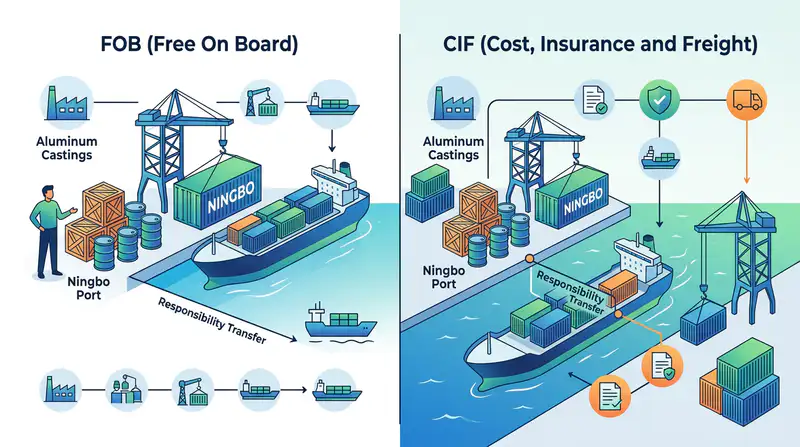
The Unique Characteristics of International Transportation of Aluminum Castings and the Impact of Trade Terms
Aluminum castings are not ordinary general cargo. They are heavy, delicate, susceptible to moisture, and irregularly shaped—these four characteristics directly cause the cost difference between choosing FOB and CIF to be magnified several times over. A 20-foot container filled with aluminum castings often weighs 22–24 tons (nearing the gross weight limit specified by SOLAS), making it a classic example of "heavy cargo." Since ocean freight is charged by weight rather than volume, choosing the wrong vessel type can result in a difference of $300–500 per container.
Even more problematic is surface oxidation. Aluminum castings that spend 30–40 days at sea and are exposed to the high temperatures and humidity of crossing the equator can suffer from white spot corrosion rates of 15–30% or higher upon unpacking at the port if the packaging has not been treated with VCI vapor-phase corrosion inhibitors. Last year, I handled a shipment of ADC12 die-cast parts destined for Rotterdam. The supplier arranged the entire shipment under CIF terms but omitted the desiccant, leading the customer to refuse delivery and file a claim for $18,000. Liability is clearer under FOB terms for such disputes, whereas under CIF terms, it is easier for parties to pass the buck.
Another often-overlooked point is the scope of coverage under marine cargo insurance. Under CIF terms, suppliers are only required to purchase the minimum insurance specified by Incoterms 2020 (ICC(C)), which does not cover the most common risks associated with aluminum castings, such as moisture damage and dents. Therefore, when shipping aluminum castings from China, the choice between FOB and CIF essentially comes down to assessing "who better understands the vulnerabilities of this shipment."
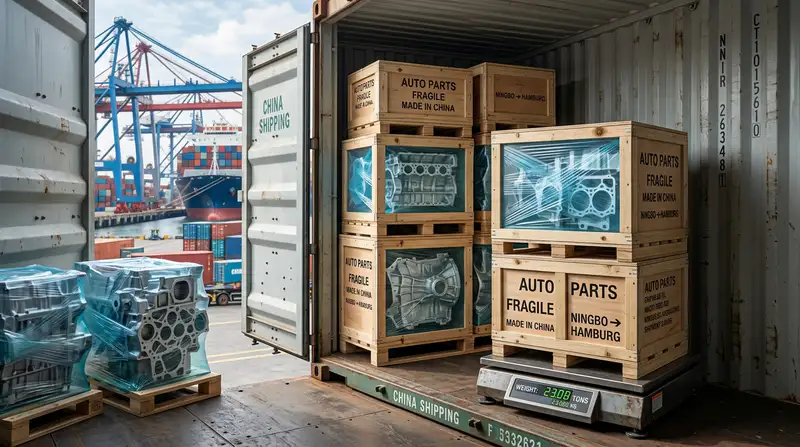
Moisture-proof packaging for shipping aluminum castings by container on a FOB or CIF basis from China
The Complete Process for Purchasing Aluminum Castings from China Under FOB Terms
The point of responsibility under the FOB terms is the moment the goods cross the ship’s rail at the port of loading. Prior to that, the Chinese supplier is responsible for factory packing, inland trucking, customs clearance, and loading onto the vessel; thereafter, ocean freight, customs clearance at the port of destination, delivery, and import duties are all your responsibility. It sounds simple, but the devil is in the six steps that take place "before loading."
- Factory Inspection and Packaging: Aluminum castings must be packed in wooden crates or on steel pallets with bubble wrap and VCI rust-preventive paper. Export wooden packaging must bear the ISPM 15 fumigation mark; otherwise, the shipment will be detained at the port of destination under 100%.
- Inland trailers: The distance from factories in Ningbo or Shanghai to the port is typically 150–300 kilometers, and the cost for a 40-foot high-cube container is approximately ¥1,800–2,800.
- Customs Clearance and Commodity Inspection: Aluminum castings are generally classified under HS code 7616.99, with an export tax rebate rate of 13%. Suppliers must provide a pro forma invoice, packing list, and customs declaration authorization letter.
- VGM Declaration: According to the SOLAS Convention, the gross mass of containers must be submitted to the shipping line before the booking deadline; heavy cargo such as aluminum castings is often refused for shipment due to exceeding the VGM limit.
- Loaded onto the vessel and obtained the bill of lading: Once the ship crosses the line, the risk is transferred to you.
Last year, our team shipped four containers of A356 aluminum castings from the Port of Beilun in Ningbo for a German client. Because the supplier waited until just six hours before the customs deadline to submit the VGM, we missed the ship’s departure and had to reschedule for the next voyage, resulting in an 11-day delay in delivery. Since then, we have strictly required FOB suppliers to submit the VGM 72 hours before the vessel’s departure. This is the most common pitfall in the practical handling of FOB and CIF pricing when exporting aluminum castings from China.
The three major ports each have their own quirks:Shanghai YangshanIt offers the most comprehensive route network and the most reliable艙位, but trucking fees are about 151 TP3T higher than in Ningbo;Beilun, NingboIt serves as a natural export hub for the East China aluminum casting cluster (Ningbo, Taizhou, Wenzhou), with a short transport radius;Shenzhen Yantian/ShekouThis is suitable for suppliers in the Pearl River Delta, but please note that Yantian Port often experiences capacity shortages during the peak season (August–October).
Practical Advice: Under FOB terms, be sure to designate your own freight forwarder rather than letting the supplier "just handle it"—otherwise, local charges such as THC, document fees, and seal fees may be marked up by 30–50%.
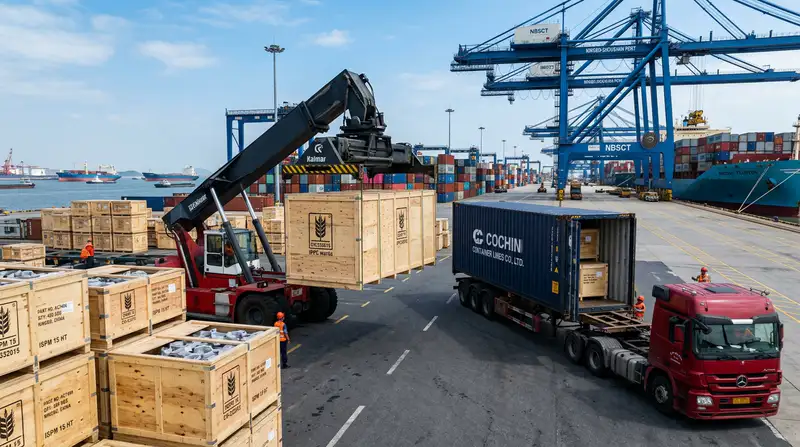
Complete Operational Process for Loading Aluminum Castings at the Port of Ningbo Under FOB Terms
Cost Components of FOB and Expenses Bearing by the Buyer
An FOB quote only covers costs up to the moment of shipment; every penny after that is on you. Take, for example, a 40-foot high-cube container loaded with approximately 26 tons of aluminum castings (a typical heavy-cargo container) shipped from the Port of Ningbo to the Port of Los Angeles/Long Beach in the U.S. In 2024, the buyer will be responsible for the following costs:
| Cost Items | Amount Range (USD) | note |
|---|---|---|
| International Ocean Freight | $2,200 – $3,800 | A PSS peak season surcharge applies during peak season |
| Cargo Insurance (ICC(A) All Risks) | $80 – $150 | 0.1–0.25% of the CIF value (TP3T rate) |
| Port of Destination THC + Unpacking Fee | $380 – $520 | Standard Fees for the Port of Los Angeles |
| Customs clearance agency fee + ISF declaration | $150 – $280 | AMS 24-Hour Advance Notice |
| U.S. Import Tariff (HTS 7616.99.51) | Value of goods × 2.51 TP3T + 301 clause 251 TP3T | Most aluminum castings fall under Schedule 301 |
| Inland delivery (port to warehouse) | $600 – $1,400 | Depending on distance and fuel surcharges |
Last year, I conducted a field test of this route for a hydraulic valve client in Ohio: the FOB Ningbo quote looked cheap at 1,850, but after adding all the C&F costs mentioned above, the total cost per box reached 1,200, which was only 340 cheaper than the supplier’s CIF quote—yet it cost our procurement team an extra 18 hours of coordination. That’sAluminum castings exported from China: FOB and CIF pricesThe "hidden labor costs" most often overlooked in decision-making.
Special Note: Tariffs under Section 301 are subject to policy changes; we recommend regularly checking the U.S. International Trade Commission’s HTS database to confirm the latest rates.
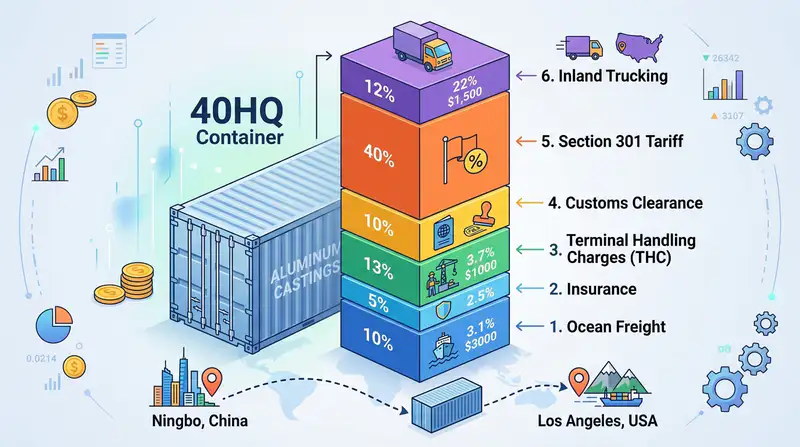
The Advantages and Hidden Risks of the Supplier Handling Transportation Under CIF Terms
Conclusion first:CIF offers you "peace of mind," but that peace of mind comes at the cost of relinquishing both pricing power and the right to claim insurance. When you choose the CIF option for exporting aluminum castings from China, the supplier handles booking the shipment, prepays the freight, and arranges minimum insurance coverage—all you have to do is wait at the destination port to clear customs and collect the goods. It sounds perfect—until the bill arrives.
The Real Advantages of CIF
- A single point of contact, eliminating the language and time zone barriers associated with communicating with Chinese freight forwarders
- Suitable for first-time buyers or small and medium-sized buyers with an annual purchase volume of less than three containers
- Suppliers who book containers in bulk often secure ocean freight rates that are 15–20% lower than those available to individual buyers.
Three Hidden Pitfalls (Based on My Own Experience)
In 2023, I handled an insurance claim for a U.S. client involving a shipment of 12 tons of aluminum die-castings, shipped CIF from Qingdao to Houston. Upon arrival at the port, it was discovered that three pallets of castings inside the container had developed white oxidation spots due to seawater seepage. The issue was that the supplier had insured the shipment underAssociation Cargo Clauses (C)(ICC-C, formerly known as WPA insurance), according to data from the International Union of Marine Insurers (IUMI), this policy covers only about 14 specific risks and does not include "moisture damage and oxidation." The final claim amount was $8,400, but the insurance company paid only $0.
| Hidden Risks | Actual impact | Recommendations |
|---|---|---|
| THC, ISPS, and DOC fees at the port of destination are to be paid by the buyer | 40-foot high-cube container: approx. 1 TP, 4 TP, 450–700 | The contract states "DTHC included" |
| Supplier designates freight forwarder to collect "document exchange fee" | Single order: 1 TP4T 80–150 | Request a direct Master B/L |
| The ICC(C) minimum coverage does not cover oxidation or dents. | Claim success rate <20% | Add ICC (A) All Risks coverage; the premium is approximately 0.151% of the cargo value. |
Cost Comparison Between FOB and CIF and Methods for Calculating Total Landed Cost
Key Findings: When exporting aluminum castings from China under FOB and CIF terms, the difference in total landed cost typically ranges from 31 to 81 percent. However, what truly determines value for money is not the quotation itself, but your ability to manage exchange rates, bunker adjustment factors (BAF), port of destination charges.
General formula for landed cost:Landed Cost = Cost of Goods + International Freight + Insurance + Customs Duties + Port Charges at Destination + Inland Delivery + Bank Fees and Exchange Rate LossTaking a 40-foot high-cube container loaded with 26 tons of aluminum castings as an example, the comparison of actual data for Q4 2024 is as follows:
| Cost Items (USD) | FOB Qingdao to Los Angeles | CIF Qingdao to Los Angeles | FOB Shanghai to Rotterdam | CIF Shanghai to Rotterdam |
|---|---|---|---|---|
| Value (aluminum castings) | 78,000 | 78,000 | 78,000 | 78,000 |
| Ocean freight + BAF | 2,850 (custom) | 3,400 (supplier markup) | 3,100 | 3,650 |
| Insurance (ICC-A 0.18%) | 145 (Self-submitted) | 65 (Minimum Insurance ICC-C) | 145 | 65 |
| THC/Customs Clearance at Port of Destination | 680 | 680 | 520 | 520 |
| Tariffs (aluminum products: 2.51%–6.1%) | 1,950 | 1,950 | 4,680 (including anti-dumping duties) | 4,680 |
| Total Landed Cost | 83,625 | 84,095 | 86,445 | 86,915 |
Last year, I evaluated two options for a client in the Texas pump industry. While FOB saved $470 per container compared to CIF, the client spent six hours booking space and coordinating with the freight forwarder—so after factoring in labor costs, the actual savings amounted to only $280.That is why CIF is actually a better deal for buyers who purchase less than five containers per year..
Two severely underestimated variables: First,Exchange rate fluctuationsFirst, the quarterly fluctuation range of the RMB against the USD is typically between 1.5% and 3%. CIF contracts are usually settled in USD to hedge against exchange rate risks, while with FOB contracts, you bear the exchange rate loss; second,Bunkering Adjustment Factor (BAF)According to data from UNCTAD’s *2023 Review of Maritime Transport*, BAF can account for 18%–25% of total shipping costs and is adjusted monthly. Once a CIF quote is signed, the rate is locked in, which may result in losses for suppliers during peak seasons—at which point you should be wary of them secretly downgrading艙位 or switching to smaller shipping lines.
How to Choose the Right Trade Terms Based on Purchase Volume and Experience
straight answer: First-time buyers should choose CIF or DAP to minimize learning costs; established importers purchasing at least two containers per month must use FOB to control freight costs; high-volume OEM customers should upgrade to FCA or DDP, with the former locking in inland transport risks and the latter providing "door-to-door" all-inclusive pricing. When exporting aluminum castings from China, FOB and CIF prices are merely the starting point, not the end.
In 2023, our team switched a U.S. automotive parts OEM client from FOB to FCA Ningbo because the client had a designated freight forwarder (NVOCC) in China. As a result, inland trucking costs dropped from USD 380 per container to USD 290, the freight forwarder handled VGM declarations directly with the shipping line, and the shipment delay rate decreased from 121 days to 3 days.
- FCA (Free Carrier): Suitable for buyers who have designated a freight forwarder; risk transfers at the factory or yard, avoiding THC disputes at the port of loading.
- DAP (Delivered at Place): Suitable for new buyers who do not have customs clearance capabilities, but the buyer is still responsible for paying any import duties.
- DDP (Delivered Duty Paid): Aluminum castings classified under HS code 7616.99 are subject to a 2.51% tariff in the U.S. (TP3T) and carry the risk of an anti-dumping review. DDP costs must be borne by the supplier; exercise caution when selecting suppliers.
The terms and conditions are governed by ICC Incoterms 2020.
Frequently Asked Questions
Q1: What type of insurance should I purchase for shipping aluminum castings by sea?When Chinese suppliers export aluminum castings from China under CIF terms (as opposed to FOB), they typically purchase only the ICC(C) minimum cargo insurance by default, with coverage amounting to 110% of the CIF value, which covers only major incidents such as fire and shipwreck. However, the most common losses for aluminum castings are moisture damage, oxidation, and dents or deformation caused by impact. These risks require upgrading to ICC(A) All Risks coverage, which increases the premium from 0.081 TP3T to approximately 0.251 TP3T. While this costs an additional $30–60 per container, it can be a lifesaver. We recommend referring to the clause explanations provided by the International Union of Marine Insurers (IUMI).
Q2: Who is responsible for cargo damage under CIF terms?The risk had already passed to the buyer at the port of shipment, and the buyer initiated the insurance claim, but both the bill of lading and the insurance policy were in the supplier’s possession— —This was a pitfall I encountered in 2023 while handling a water damage claim for a batch of machined aluminum castings in Ningbo. The back-and-forth requests for documents delayed the process by 17 days, nearly causing us to miss the insurer’s 60-day reporting deadline.
Q3: Does the FOB price include export tax rebates?Included. The export tax rebate rate for aluminum castings from China is 13.1%. This has already been factored into the supplier’s quote, so no additional action is required on the buyer’s part.
Q4: How can I determine if a freight forwarder’s quote is reasonable?When comparing benchmark ocean freight rates using the Freightos Baltic Index, be cautious if the deviation exceeds 151 TP3T.