














Guide to Selecting and Purchasing Aluminum Alloy Castings for Automobiles: A Case Study from Ningbo Hexin
Excerpt:
How can you balance strength, lightweight design, and cost when sourcing automotive aluminum alloy castings? Drawing on real-world case studies from multiple original equipment manufacturers (OEMs), Ningbo Hexin breaks down process selection, mold development, quality control, and delivery lead times to help you quickly assess a supplier’s reliability.
Article Catalog[Hidden]
- Key Points
- Key Highlights
- What Are Aluminum Alloy Castings for Automobiles, and What Problems Do They Solve?
- Main Applications and Selection Criteria for Aluminum Alloy Castings in Automobiles
- Common Aluminum Alloy Casting Grades and a Comparison of Their Properties
- A Comparison of Die Casting, Low-Pressure Casting, and Gravity Casting Processes
- A Detailed Explanation of the Five Major Forming Processes for Automotive Aluminum Alloy Wheels
- Current Status and Application Limits of Integrated Die-Casting Technology
- Common Defects in Aluminum Alloy Castings and Key Points for Quality Control
- The Effect of Heat Treatment and Surface Treatment on the Properties of Castings
- Analysis of the Actual Cost Structure of Aluminum Alloy Castings for Automobiles
- How to Evaluate and Select Suppliers of Aluminum Alloy Castings
Automotive aluminum alloy castings are metal parts used in vehicles that are produced by pouring molten aluminum alloy into a mold and allowing it to cool and solidify; their core value lies in weight reduction—at the same strength, aluminum has a density of only about one-third that of steel. In 2021, the market size for automotive aluminum castings in China was approximately 1355億元人民幣, while the global market was approximately 3521億元; by 2026, cast aluminum alloys are expected to account for about 80% of the total aluminum used in the automotive sector. For every 100 kilograms of weight reduced in an electric vehicle, its driving range can increase by approximately 6%–8%.
Key Points
- New energy battery trays and motor housings are currently the key growth areas for aluminum castings
- The transmission housing is manufactured using low-pressure casting to ensure that the oil and coolant passages are airtight and leak-free.
- High-pressure die casting is used for the body shock absorber towers and longitudinal beam joints to ensure elongation and impact resistance.
- For steering knuckles and control arms, where fatigue resistance is critical, choose low-pressure or gravity casting.
- Casting is the preferred method for complex, irregularly shaped parts with internal cavities, as it reduces welding and machining costs.
Key Highlights
- For every 100 kg of weight reduced from an electric vehicle, its range increases by approximately 6%–8%.
- Die casting is suitable for thin-walled parts under 3 mm and high-volume production of 50,000 or more units per year.
- A380 and ADC12 are the most commonly used die-casting alloys for automotive structural components.
- Low-pressure die casting offers high density and is suitable for load-bearing components such as wheel hubs.
- For factory audits, first check for IATF 16949 certification and porosity test reports.
What Are Aluminum Alloy Castings for Automobiles, and What Problems Do They Solve?
Automotive aluminum alloy castings are metal parts used in vehicles that are produced by pouring molten aluminum alloy into a mold and allowing it to cool and solidify. Their core value lies in weight reduction: at the same strength, aluminum has a density of only about one-third that of steel. By 2026, cast aluminum alloys are projected to account for approximately 80% of the total aluminum used in automobiles, making them the primary material for bodyweight reduction. They directly address key challenges such as high fuel consumption, short driving range, and high unsprung mass.
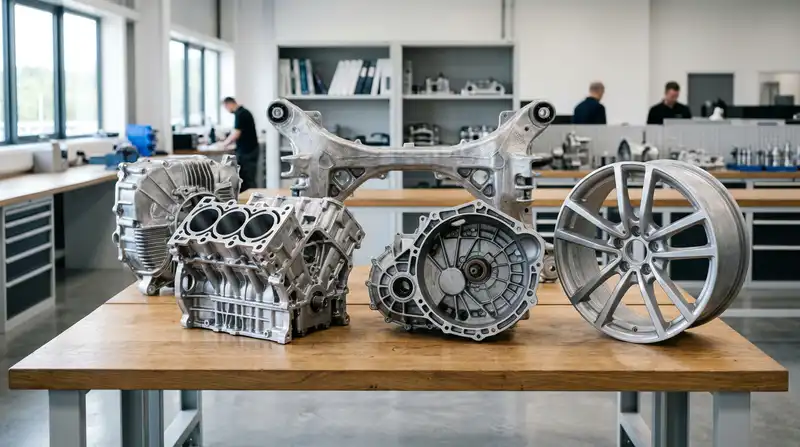
In a complete vehicle, aluminum alloy castings are used in key components ranging from the powertrain to the chassis. Engine blocks, cylinder heads, and transmission housings are the most classic applications; these parts have complex shapes and internal oil and coolant passages, and casting allows them to be formed in a single process, eliminating the need for extensive machining. Chassis structural components such as wheel hubs, subframes, steering knuckles, and strut towers utilize aluminum castings to reduce unsprung mass, thereby enhancing handling and ride comfort.
Why not just use steel? The answer lies in the total cost, not just the unit price. Aluminum costs more per kilogram than steel, but the weight savings yield greater overall benefits.
- Reducing the Vehicle's Overall Weight: An aluminum alloy cylinder block is about 40% lighter than a cast iron cylinder block, saving more than ten kilograms per engine.
- Fuel Consumption and Emissions: For every approximately 10% reduction in vehicle weight, fuel consumption decreases by approximately 6%–8%, which is critical for compliance with emissions regulations.
- Range of New Energy Vehicles: For every 100 kilograms of weight reduced from an electric vehicle, its range can increase by approximately 6%-11%; as a result, aluminum castings have become standard equipment in new energy vehicles.
This is also the reason behind the market’s rapid expansion. In 2021, the market size of China’s automotive aluminum castings reached approximately 135.5 billion yuan. Ningbo Hexin, which specializes in aluminum alloy casting molds and products, is also shifting its focus to the new energy sector in low-pressure casting, precisely because it has recognized this growth trend.
Main Applications and Selection Criteria for Aluminum Alloy Castings in Automobiles
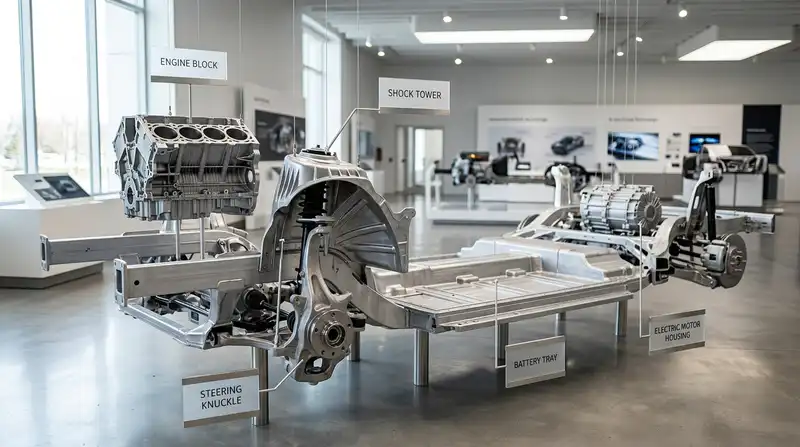
Automotive aluminum alloy castings are primarily used in four major systems: the powertrain, chassis, body structure, and the “three electrical systems” of new energy vehicles. The key reason these components are cast rather than forged or extruded is that casting allows for the formation of complex internal cavities and irregular shapes in a single process. Industry data from 2026 shows that approximately 55.1% of automotive aluminum alloys were produced via high-pressure die casting, far exceeding the approximately 1.7% produced via forging.
What are the different requirements for castings depending on their location?
Each system prioritizes different performance characteristics. The table below outlines the emphasis placed on strength, airtightness, and thermal conductivity.
| Application Systems | Typical Castings | Primary Performance Requirements | Common Processes |
|---|---|---|---|
| powertrain | Cylinder block, transmission housing | Leak-tightness (Prevention of Oil and Water Leaks) | Low-pressure casting |
| Chassis | Steering knuckles, control arms | Fatigue Strength | Low Pressure/Gravity |
| Body Structure | Shock-Absorbing Tower, Longitudinal Beam Joint | Elongation, Impact Resistance | High Pressure Die Casting |
| Battery Tray | Lower Chassis Housing | Air Tightness + Thermal Conductivity | Extrusion and spot welding or one-piece die casting |
| Motor Casing | Stator housing, end cap | Heat Conduction and Dissipation | High Pressure Die Casting |
Why aren't these parts forged?
Forged parts are stronger, but they can only be made in simple, solid shapes and are more expensive per unit. Transmission housings contain oil passages and coolant channels; forging simply cannot produce such internal cavities. Extrusion can only produce profiles with uniform cross-sections and cannot be used for irregularly shaped parts. Casting allows for the formation of complex internal cavities, reinforcing ribs, and mounting seats in a single process, eliminating the need for extensive welding and machining.
From the perspective of Ningbo Hexin’s product selection, battery trays and motor housings are currently the focus. These new energy components must be airtight to prevent coolant leakage, while also relying on aluminum’s thermal conductivity to dissipate heat from the motor. Low-pressure die casting produces dense, low-porosity castings that perfectly meet these airtightness requirements, which is precisely why the company is expanding into the low-pressure die casting sector for new energy applications.
Common Aluminum Alloy Casting Grades and a Comparison of Their Properties
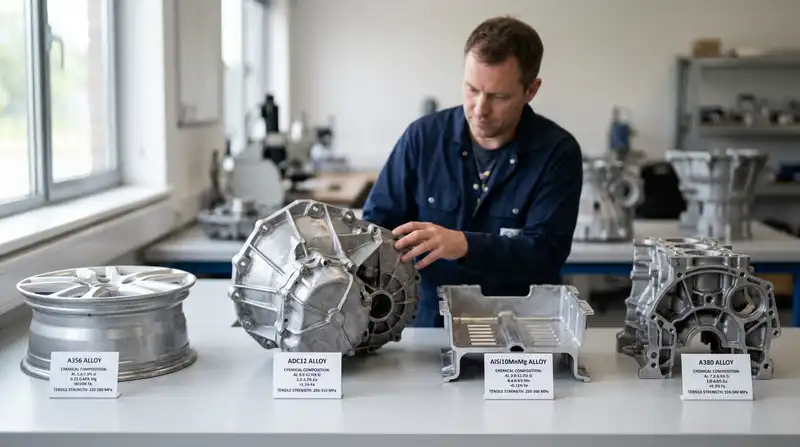
The four most commonly used grades of aluminum alloy castings for automobiles are A356, ADC12, AlSi10MnMg, and A380. A356 is used for load-bearing components such as chassis and wheel hubs; ADC12 and A380 are commonly used in die casting; and AlSi10MnMg was specifically developed for one-piece die casting applications that do not require heat treatment. Selecting the wrong grade can directly lead to part cracking or failure to meet strength requirements, so selecting the correct grade is the first step in the procurement process.
The key differences among the four grades lie in their silicon content and alloying elements. Silicon (Si) improves the fluidity of molten aluminum, making it easier to fill thin-walled, complex cavities; magnesium (Mg) and copper (Cu) enhance strength. Die-cast parts require high fluidity, so ADC12 and A380 have high silicon content; load-bearing parts require toughness, so A356 has low silicon content and is strengthened through T6 heat treatment.
| grades | silicon content | Tensile strength (T6 state) | elongation | typical use |
|---|---|---|---|---|
| A356 | 6.5%–7.5% | 280–330 MPa | 6%-10% | Wheels, steering knuckles, subframe |
| ADC12 | 9.6%–12% | 230–280 MPa | 1%–3% | Transmission housing, oil pan |
| AlSi10MnMg | 9%–11% | 250–310 MPa | 5%–10% | Integrated Die-Cast Body Parts |
| A380 | 7.5%–9.5% | 250–320 MPa | 2%–4% | Engine block, mount |
Elongation is a key indicator that measures how much a material can be stretched before it breaks. Since one-piece die-cast parts cannot undergo heat treatment (due to the risk of deformation), heat-treatment-free alloys such as AlSi10MnMg are selected; these offer an as-cast elongation of 5% or higher, making them less prone to shattering upon impact. In 2026, automotive aluminum alloys with an elongation of approximately 55.1% will be produced using high-pressure die casting, making this die-casting grade the most in demand.
Ningbo Hexin specializes in low-pressure die casting for the new energy sector. For large-sized components such as battery trays, the company recommends prioritizing an evaluation of the airtightness performance of AlSi10MnMg and A356 rather than focusing solely on strength values.
A Comparison of Die Casting, Low-Pressure Casting, and Gravity Casting Processes
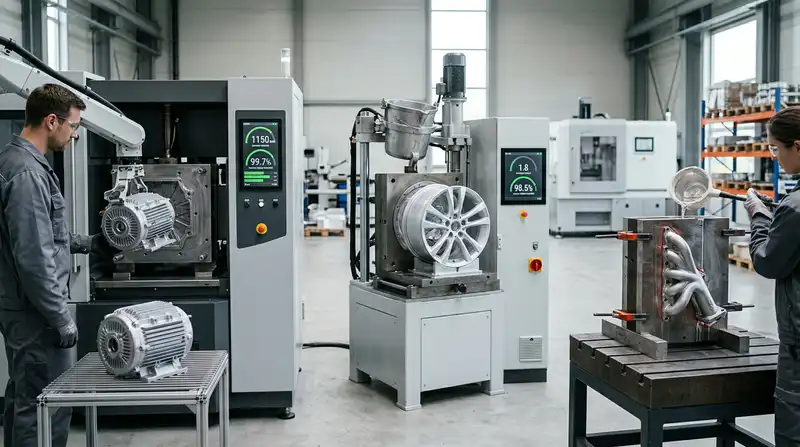
The key difference between die casting, low-pressure casting, and gravity casting lies in the pressure at which molten aluminum enters the mold: die casting uses high-pressure, rapid filling at 30–150 MPa; low-pressure casting uses slow filling at 0.02–0.06 MPa; and gravity casting relies solely on the molten aluminum’s own weight to flow into the mold. Industry data from 2026 shows that approximately 55.1% of automotive aluminum alloys were produced using high-pressure die casting. Higher pressure results in faster molding and lower costs, but it also increases the risk of internal porosity.
Choosing the wrong process can directly affect whether a part can undergo heat treatment. Ordinary die-cast parts often contain many internal pores; when heated, the expanding gas causes bubbling, so load-bearing parts are typically produced using low-pressure or gravity die-casting processes.
| comparison dimension | High Pressure Die Casting | Low-pressure casting | Gravitational casting |
|---|---|---|---|
| Filling Pressure | 30–150 MPa | 0.02-0.06 MPa | Dead weight only |
| Internal Density | Lower (prone to porosity) | your (honorific) | high |
| Dimensional accuracy | Levels CT5–CT6 | Levels CT6–CT7 | Levels CT7–CT8 |
| Mold life | 80,000–120,000 cycles | 100,000–150,000 cycles | 50,000 cycles or more |
| Typical Components | Integrated body and motor housing | Chassis, Wheels | Exhaust manifolds, small-batch parts |
High-vacuum die casting is an advanced version of conventional die casting: before molding, the mold cavity is evacuated to a negative pressure below 50 mbar, reducing porosity to within 1% and enabling the die-cast parts to undergo welding and heat treatment. This technique is used to produce integrated die-cast rear base plates and motor housings. Ningbo Hexin operates its own production lines for all three types of molds—low-pressure, gravity, and high-pressure—as well as the corresponding products. This allows the company to match the most cost-effective molding solution to the stress requirements of each component, rather than applying a single process to all parts indiscriminately.
A Detailed Explanation of the Five Major Forming Processes for Automotive Aluminum Alloy Wheels
The five major forming processes for aluminum alloy wheels are low-pressure die casting, gravity casting, spin forming, forging, and semi-solid forming. Among these, low-pressure die casting is currently the mainstream process for passenger car wheels, accounting for more than 70 percent of the market. According to 2026 industry data, cast aluminum alloys account for approximately 80% of the total aluminum used in the automotive sector, with wheels serving as the primary application for this volume. Choosing the wrong process can directly lower yield rates and drive up unit costs.
There is a significant gap in cost and performance among these five processes, as illustrated in the table below:
| arts and crafts | Typical Yield | Relative Cost | Mechanical Properties and Characteristics |
|---|---|---|---|
| Low-pressure casting | Approx. 90% | center | Dense texture, few pores |
| Gravitational casting | Approx. 75% | lower (one's head) | Mechanical properties are average; prone to shrinkage porosity |
| Spinning (Low Pressure + Spinning) | Approx. 85% | mid-to-high | Improved rim strength, with a weight reduction of 15% |
| forge (metal) | Approx. 80% | your (honorific) | Highest fatigue strength and highest density |
| Semi-solid molding | Approx. 88% | your (honorific) | Good formability, low porosity |
The fatigue life of forged wheels can be two to three times that of low-pressure die-cast wheels, but the unit cost is also more than double, so they are primarily used in high-performance vehicles and race cars. Spinning involves heating a low-pressure casting blank and then using a spinning machine to roll the rim (the outer edge of the wheel), causing the metal’s grain structure to realign. This process achieves strength levels close to those of forged wheels without requiring significant equipment modifications, offering outstanding value for money.
Ningbo Hexin recommends that low-pressure casting be the preferred method for mass-producing passenger car wheel hubs, as it ensures a denseAutomotive Aluminum Alloy CastingsIt is both efficient and cost-effective; for mid- to high-end models with strict weight reduction requirements, the combined process of low-pressure forming and spin forming is more cost-effective.
Current Status and Application Limits of Integrated Die-Casting Technology
Integrated die casting is a technology that uses a single, ultra-high-tonnage die-casting machine to form a single automotive aluminum alloy casting in a single process, replacing what would otherwise require dozens of stamped and welded parts. The current status of its development is as follows: it is already in mass production for the rear floor panels of high-end electric vehicles with an annual production capacity of over 300,000 units, but it is not cost-effective for all vehicle models. From 2021 to 2025, the compound annual growth rate (CAGR) for demand for automotive aluminum alloy die-cast parts is expected to be approximately 10.2%, and integrated die-casting is one of the drivers of this growth.
What are the specific requirements for molds and equipment in integrated die casting?
The key challenge is clamping force. Molding a rear floor panel requires a die-casting machine with a clamping force of over 6,000 metric tons, while some front-end components require 9,000 metric tons. The cost of a single mold set is often in the tens of millions of yuan, far exceeding that of ordinary die-casting molds. Additionally, heat-treatment-free alloys (such as AlSi10MnMg) must be used because the parts are so large that heat treatment would cause deformation that cannot be corrected by remelting.
Why isn't one-piece die-casting cost-effective for all vehicle models?
This is a counterintuitive point that most articles overlook. The high cost of die-casting molds can only be justified by spreading the cost across high production volumes. Here’s a simple calculation: if a single mold costs 20 million yuan and has a lifespan of 100,000 cycles, the cost per unit for a model with an annual production of 50,000 vehicles is about 400 yuan; but for a model with an annual production of 10,000 units, the cost per unit soars to 2,000 yuan. For low-volume models, traditional welded assemblies are actually more cost-effective.
Another point of contention is maintenance costs. After a collision, monoblock castings cannot be replaced in parts; the entire component must be scrapped, leading to a general increase in insurance claims assessments. Yield rate is also a major challenge: due to the long filling paths in oversized parts, the risk of shrinkage cavities and gas pores is high, and the yield rate during the initial stages of mass production is often lower than that of 70%. Ningbo Hexin recommends first verifying the stability of heat-treatment-free alloys in low-pressure and gravity casting parts before assessing whether to move into one-piece die casting, thereby avoiding blindly chasing new technologies.
Common Defects in Aluminum Alloy Castings and Key Points for Quality Control
The five most common types of defects in automotive aluminum alloy castings are porosity, shrinkage, inclusions, cold shuts, and hot cracks. Their causes vary, and so do the methods used to detect them. Die-casting accounts for over 70% of automotive aluminum castings (2022 industry data), and high-speed filling is precisely the stage where porosity and cold shuts are most likely to occur. Distinguishing between these five types of defects is the first step in assessing a supplier’s quality capabilities.
What causes these five types of defects, and how are they detected?
Pores are caused by entrapped gas, while shrinkage cavities are voids left behind when molten aluminum contracts during solidification and the void is not fully filled; both are detected using X-ray fluoroscopy or industrial CT scans. CT provides three-dimensional imaging and can measure the actual volume and location of internal defects, whereas X-rays only provide two-dimensional projections.
- stoma: If air or hydrogen is entrapped during casting, a leak test (in which gas is pressurized into the casting to check for leaks) can locate through-hole porosity; this test is mandatory for pressure-bearing housing components.
- shrinkage: Thick, large sections solidify last and are prone to shrinkage defects; industrial CT is the gold standard for determining the shrinkage porosity rate. For load-bearing components, the shrinkage porosity area is generally required to be less than 1%.
- slagging: When alumina slag or flux residues are mixed into the molten aluminum, they appear as high-density spots on X-ray images; therefore, the filtration and refining of the melt must be controlled.
- cold storage: When two streams of molten aluminum converge, the temperature is too low for them to fuse, resulting in linear cracks on the surface, which are detected through visual inspection and penetrant testing.
- thermal crack: Tears caused by thermal stress during the late stage of solidification, which frequently occur at points of structural change; improper design of the mold temperature distribution is the primary cause.
What key elements should a qualified supplier’s quality system cover?
The key is to prevent defects before products leave the factory; the quality system should cover three stages: melt management, process monitoring, and finished product inspection. During the melt stage, hydrogen content is controlled and slag is removed through refining; during the process stage, key parameters such as mold temperature and injection speed are strictly controlled; and during the finished product stage, X-ray, CT, or leak testing is conducted on a random basis according to part grade. Ningbo Hexin’s approach is to incorporate molding analysis for low-pressure, gravity, and high-pressure processes into the mold design phase. By using product molding analysis to predict the risks of shrinkage porosity and cold shuts in advance, the company reduces the scrap rate at the source.
The Effect of Heat Treatment and Surface Treatment on the Properties of Castings
The heat treatment of automotive aluminum alloy castings determines whether they can be used in load-bearing components: The T6 condition can increase the tensile strength of A356 from approximately 180 MPa in the as-cast state to over 290 MPa, while doubling its yield strength. Surface treatment, on the other hand, determines durability and appearance, rather than strength. Together, these two processes constitute the final value-added step before the castings leave the factory.
What is the difference between T6 and T7 states?
T6 is designed for maximum strength, while T7 sacrifices a little strength for stability. Both are first subjected to solution treatment (heating the casting to approximately 535°C and holding it at that temperature to allow the alloying elements to dissolve into the aluminum matrix), followed by artificial aging.
- T6 (Peak Delivery Time): The aging temperature is approximately 155–175°C; this grade offers the highest strength and is used for load-bearing components such as wheel hubs and steering knuckles.
- T7 (aged): It has a higher aging temperature and a longer aging time; while strength is slightly reduced, residual stress is low and dimensional stability is high, making it suitable for precision assemblies.
Note: AlSi10MnMg, commonly used in one-piece die casting, is a heat-treatment-free alloy; this step is skipped precisely to avoid the hassle of solution-treatment deformation.
How much do anodizing, powder coating, and machining each add to the cost?
Surface treatments are applied as needed, resulting in significant cost variations. Anodizing or coating is commonly used on wheel hubs to enhance corrosion resistance, while machining is used on assembly surfaces to ensure dimensional tolerances. By 2026, cast aluminum alloys are expected to account for approximately 80% of the total aluminum used in automobiles, and post-processing directly affects the final yield rate of these parts.
| arts and crafts | Main Functions | Typical Cost Breakdown |
|---|---|---|
| anodic oxidation | Corrosion Resistance + Surface Hardening | 5%–10% |
| Spray Coating | Appearance + Corrosion Protection | 3%–8% |
| machining | Ensuring Assembly Tolerances | 15%–30% |
Ningbo Hexin recommends that when evaluating suppliers, one should consider both the temperature control accuracy of heat treatment furnaces and machining capabilities, rather than simply comparing the unit price of castings.
Analysis of the Actual Cost Structure of Aluminum Alloy Castings for Automobiles
The cost of automotive aluminum alloy castings consists of five components: materials, mold amortization, energy consumption, yield loss, and post-processing. Among these, materials typically account for 45% to 60% of the unit cost, making it the largest expense. Once you understand this structure, you’ll be able to see through a quote that’s 20% below the industry average—the savings are most likely "achieved" at the expense of mold life or yield rates.
Material costs are the most transparent, but they are also the most susceptible to cost-cutting. Aluminum ingots are priced by the metric ton; the material costs for A356 and ADC12 differ, and the proportion of scrap aluminum added directly affects the price. If too much scrap aluminum is added, causing the iron content to exceed the limit, the castings will become brittle—this is the most common hidden risk associated with low bids.
Why does mold amortization determine the true unit cost of small-batch parts?
Mold amortization involves spreading the cost of producing a set of molds evenly across the total number of parts it can produce over its entire service life. A set of high-pressure die-casting molds can easily cost hundreds of thousands to millions of yuan, with a service life of approximately 100,000 to 150,000 cycles. If an order is placed for only 5,000 units, the tooling cost per unit becomes prohibitively high; however, if an order is placed for 50,000 units, the cost per unit is immediately diluted. Therefore, for the same automotive aluminum alloy casting, the reasonable unit price can vary by more than 30% depending on the order quantity.
This is why Ningbo Hexin asks about annual usage when providing a quote: by conducting mold structure and molding analyses upfront, they can provide a realistic amortization range, rather than using an artificially low unit price to attract orders and then making up the difference through subsequent changes.
What Quality Risks Lie Behind Low Quotes?
Energy consumption and yield losses are two "hidden" costs. The smelting of molten aluminum consumes a high amount of electricity per metric ton, and for every 5% drop in yield, the materials, electricity, and labor hours spent on scrap parts are all wasted. Industry data from 2026 shows that approximately 55.1% of automotive aluminum is produced via high-pressure die casting, precisely because this method is highly efficient and helps offset these losses. Suppliers offering abnormally low quotes often fail to meet yield standards and mix scrap parts with合格 products in their shipments.
| cost item | percentage | Common Tactics for Underbidding |
|---|---|---|
| makings | 45%–60% | Excessive amount of scrap added to the furnace; iron content exceeds the limit |
| Amortization of molds | 10%–20% | Use inexpensive molds with a short service life |
| Energy consumption | 8%–12% | Unstable Temperature Control During Smelting |
| Yield Loss | 5%–15% | Scrap Mixed into the Delivery |
| Post-processing | 10%–20% | Skip X-ray inspection |
How to Evaluate and Select Suppliers of Aluminum Alloy Castings
When selecting a supplier of automotive aluminum alloy castings, first look for these three essential criteria: IATF 16949 certification, APQP/PPAP process capabilities, and independent testing equipment. If any one of these is missing, problems are highly likely to arise during mass production. In 2021, the Chinese automotive aluminum casting market reached approximately 135.5 billion yuan. While there are many suppliers, only a few can reliably supply automotive-grade components. Below is a due diligence checklist that you can use to directly score potential suppliers.
What qualifications and competencies are the hard criteria that must be verified?
IATF 16949 is the ticket to the automotive industry; without it, you won’t even qualify to submit a bid as a Tier 1 supplier. But the certification is just the starting point—what really matters is on-site capability.
- IATF 16949 Certification: Check whether the certificate’s validity period and scope of certification cover the processes you need (die casting/low-pressure casting/gravity casting); if the scope doesn’t match, it’s as good as nothing.
- Equipment Capabilities: For die casting, it is important to ensure that the clamping force (in metric tons) is appropriate for the part’s projected area; integrated parts often require 6,000 metric tons or more. For low-pressure die casting, the precision of the furnace’s pressure-holding capability is critical.
- Testing Methods: X-ray inspection to detect internal porosity and shrinkage, coordinate measuring machine (CMM) to measure dimensions, and a spectrometer to verify alloy composition—if any one of these is missing, the inspection is considered blind.
- APQP/PPAP Process: Require the other party to provide a complete PPAP documentation package (including PSW, dimensional reports, and material certifications), which serves as a written commitment to mass production consistency.
How do we conduct an on-site review of sample validation and production capacity?
Conduct at least three rounds of testing during the sample phase: first-article inspection to verify dimensions, small-batch testing to verify yield, and continuous production testing to verify stability. Include the required Cpk (process capability index) in the contract; the Cpk for critical dimensions should be ≥1.33.
Ningbo Hexin’s approach is to first conduct product forming analysis and mold structure analysis before tooling up, thereby eliminating defects such as shrinkage porosity and cold shuts during the mold flow simulation stage, rather than waiting for mass production to require rework. This integrated capability—from mold design to finished product—is precisely the key factor in determining whether a manufacturer specializing in aluminum alloy casting is capable of producing automotive-grade components. When evaluating production capacity, don’t just look at the number of machines; verify each machine’s daily output, the mold set-up plan, and the ramp-up period to ensure the supplier can handle fluctuations in your order volume.