














A Guide to Chinese Aluminum Casting Suppliers and Their In-House CNC Machining Capabilities
Excerpt:
What does it mean for a Chinese aluminum casting supplier to have its own CNC machining equipment? From production processes, machining precision, and quality control to typical application scenarios, this article helps engineering and procurement professionals gain a comprehensive understanding of the true capabilities and limitations of such suppliers, laying a technical foundation for future selection decisions.
Article Catalog[Hidden]
- Key Points
- Key Highlights
- What is a Chinese aluminum casting supplier with its own CNC machining equipment?
- How can you tell if a supplier actually operates its own CNC machines or outsources production to a third-party manufacturer?
- What is the complete manufacturing process for aluminum castings, from die casting to CNC finishing?
- How much difference is there in lead times and tolerances between using a single-source supplier and separate outsourcing?
- What technical parameters should be considered when evaluating a supplier’s CNC equipment and machining accuracy?
- What items should overseas buyers check during a remote factory audit?
- For which procurement projects is it appropriate to choose a supplier that offers integrated casting and CNC services?
- Faqs
- Summary and Selection Action List
Chinese aluminum casting suppliers equipped with their own CNC machining equipment refer to integrated factories that perform both aluminum alloy casting (die casting, low-pressure casting, and gravity casting) and precision machining using their own CNC machines within the same facility. According to data from Grand View Research, the global aluminum casting market size exceeded approximately $105 billion in 2025, with more than 65% of export orders going to such integrated factories. In-house CNC machining can tighten tolerances from ±0.3 mm to ±0.02 mm, eliminating the need for secondary processing at other facilities, with a single supplier fully guaranteeing both delivery times and quality throughout the entire process.
Key Points
- With our in-house CNC capabilities, we can tighten tolerances from ±0.3 mm to ±0.02 mm, eliminating the need to outsource to a second manufacturer.
- To verify authenticity, first ask for the machine tool invoice and serial number; the subcontractor cannot provide the registration records.
- Participants are required to walk up to the machine tool during a video call and state the control system model; pre-recorded videos are difficult to fake.
- When selecting a machine, first determine the die-casting machine tonnage (250–4,000 metric tons) and the number of CNC axes (3 or 5).
- Pure foundries offer lower quotes—10–approximately 151 TP3T—but the total cost ends up being higher after adding outsourcing and logistics expenses.
Key Highlights
- In 2025, the global aluminum castings market exceeded $105 billion, with approximately 65% in export orders going to integrated plants.
- Since the introduction of CNC, tolerances have been tightened from ±0.3 mm to ±0.02 mm, eliminating the need for secondary processing at another facility.
- The integrated production line consists of four major components: a melting furnace, a die-casting machine, a CNC machining center, and a coordinate measuring machine.
- When selecting a machine, first consider the die-casting machine’s tonnage (250–4,000 metric tons) and the number of CNC axes (3-axis vs. 5-axis).
- Quotes from pure foundries may seem low—10–about 151 TP3T—but when you factor in outsourced machining and logistics, the total cost ends up being higher.
What is a Chinese aluminum casting supplier with its own CNC machining equipment?
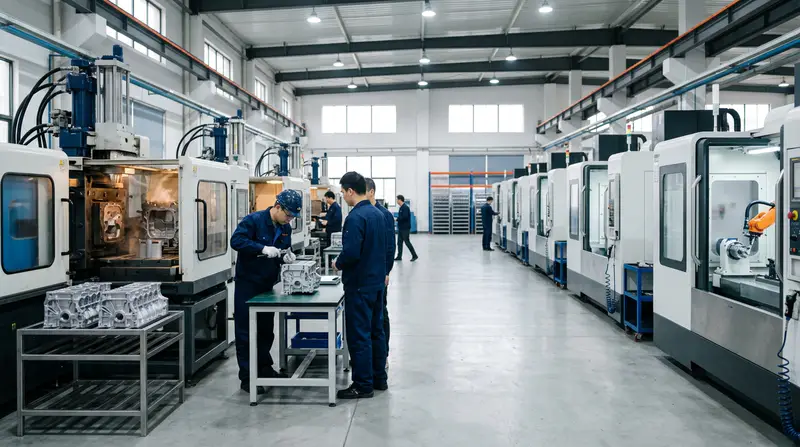
A Chinese aluminum casting supplier equipped with its own CNC machining equipment refers to a single factory that, within the same facility, performs aluminum alloy casting (die casting, low-pressure casting, and gravity casting) and carries out the subsequent precision machining of castings using its own CNC machines (computer-numerical-control machines, which are automated cutting tools controlled by computers). According to 2025 global aluminum casting market data, the global market size has exceeded approximately $105 billion, with more than 65% of export orders going to such integrated casting and machining facilities. This means that a single supplier is fully responsible for dimensions and delivery times throughout the entire process, eliminating one source of potential disputes for the buyer.
Why are the boundaries of liability so critical? The roles of these three types of suppliers are completely different, and liability for compensation varies depending on who is at fault when a problem arises.
- One-Stop Supplier: Casting and CNC finishing are both completed in-house; any dimensional deviations are immediately reworked internally, with a single entity taking full responsibility for both delivery times and quality. Factories like Ningbo Hexin, which possess the capability to manufacture low-pressure, gravity, and high-pressure molds as well as produce finished products, fall into this category.
- Pure Foundry: Only rough-machined parts are supplied; critical hole positions and flatness must be handled by a separate machining shop, and it is a common risk that the two factories will pass the blame back and forth.
- Pure CNC Machining Shop: We only accept raw castings for finishing; we do not address internal defects such as casting porosity or shrinkage.
- Trader: No in-house production lines; orders are simply passed on to third parties, making it impossible for the purchaser to verify the true source of the manufacturing process.
The criteria are straightforward: whether casting and CNC machining are performed on the same factory premises is one of the mandatory screening criteria listed in the 2026 International Procurement Guide.
How can you tell if a supplier actually operates its own CNC machines or outsources production to a third-party manufacturer?
The most reliable way to determine whether a Chinese aluminum casting supplier has its own CNC machining equipment is to request equipment invoices or fixed asset registration forms. Factories that genuinely own the equipment can provide machine tool purchase invoices, serial numbers, and depreciation records, whereas those that outsource this work cannot. According to 2025 data, more than 65% of global aluminum casting export orders went to factories that integrate casting and finishing under one roof; verifying this information is directly related to delivery risk.
Five clues that can be verified remotely:
- Equipment Invoices / Asset Registration: When asked to provide the machine tool brand, serial number, and purchase invoice, the subcontractor only vaguely states that "our partner has the equipment."
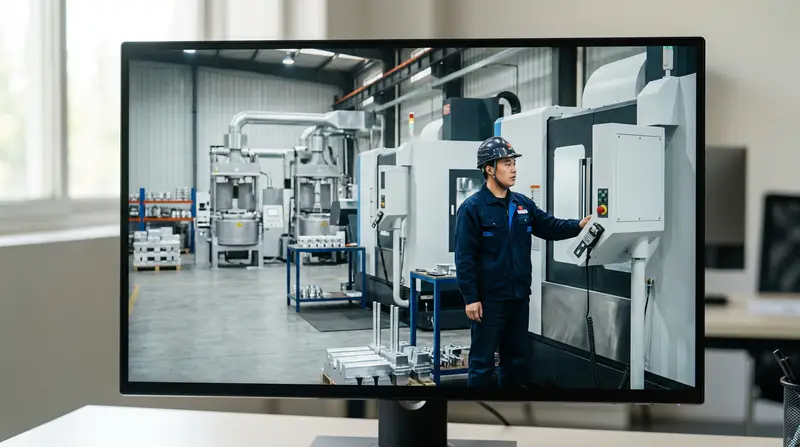
- Real-Time Video from the Workshop: During a video call, ask the other party to walk to a specific machine tool and state the model number of the screen control system; recorded videos cannot be faked.
- Employee ID Numbers and Schedules: A genuine factory can provide the employee ID numbers of its CNC operators and their monthly work schedules.
- Processing Work Order Log: Reviewing the work order numbers from the past 30 days, the continuous sequence indicates that our in-house production line is operational.
- Breakdown of Processing Fees in the Quote: Quotes for in-house equipment list materials, casting, and CNC machining separately; outsourced manufacturers often bundle machining costs into a vague total price—and that’s where the loophole lies.
Ningbo Hexin's advice is: First, ask for the invoice; then, review the video; and only after both match should you negotiate the price.
What is the complete manufacturing process for aluminum castings, from die casting to CNC finishing?
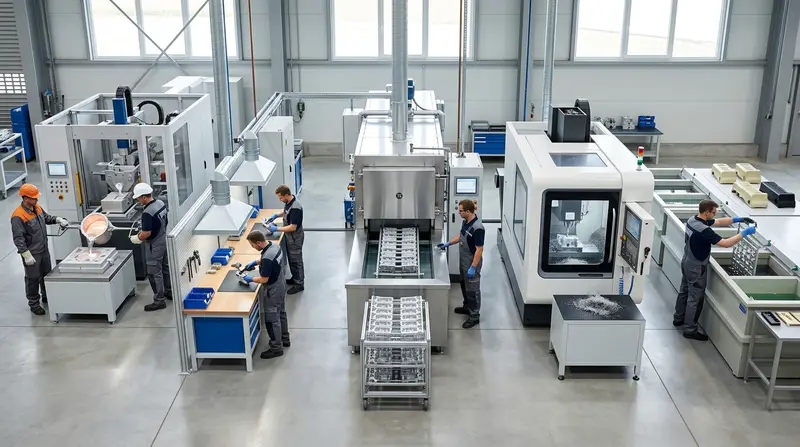
The complete manufacturing process for aluminum castings consists of five steps: casting (low-pressure/gravity/high-pressure) → deburring → heat treatment → CNC finishing → surface treatment. According to a 2026 industry assessment, the CPK target for critical dimensions should be set at ≥1.33. This means that cumulative tolerances must be controlled during both the casting and machining stages; relying solely on corrective CNC machining in the final step is insufficient.
Each step results in cumulative tolerances (errors piling up layer by layer). The shrinkage rate during the casting stage is typically between approximately 0.5% and 1.2%, which is the largest source of error; heat treatment (which alters the internal structure of the metal at high temperatures to increase its strength) causes the workpiece to deform once again.
Ningbo Hexin’s actual production sequence for low-pressure die-cast parts in the new energy sector is worth noting: After low-pressure die casting, the parts are first deburred, then undergo T6 heat treatment to stabilize their dimensions, and finally undergo in-house CNC machining to finish the critical assembly surfaces. CNC machining is performed after heat treatment because any secondary deformation caused by the heat treatment would render the machining ineffective if done first; this is also the key to how Chinese aluminum casting suppliers with in-house CNC machining equipment can save on rework costs. Surface treatments (such as anodizing) are performed last to avoid scratching the finished surface during machining.
How much difference is there in lead times and tolerances between using a single-source supplier and separate outsourcing?
Integrated suppliers (where casting and CNC machining are completed on the same premises) typically shorten lead times by 5 to 10 days compared to the "foundry + outsourced CNC" model, and can consistently maintain critical dimensional tolerances within ±0.05 mm. According to 2025 data, global export orders for aluminum castings exceeding 65% were directed to integrated casting and finishing facilities. This is because separate outsourcing introduces additional logistics and secondary incoming inspection steps, thereby amplifying both time and quality risks.
?? Common Mistakes: We selected a pure foundry based solely on the quote, as its price was 10–15% lower than that of an integrated factory. Reason: The rough castings still require outsourcing for precision machining of critical holes; when outsourcing fees and logistics costs are added, the total cost actually becomes higher. Furthermore, the two factories tend to pass the blame onto each other, making it difficult to tighten tolerances from ±0.3 mm to ±0.02 mm. Solution: Prioritize integrated suppliers that perform both casting and CNC machining in-house, and compare prices based on total cost rather than unit price.
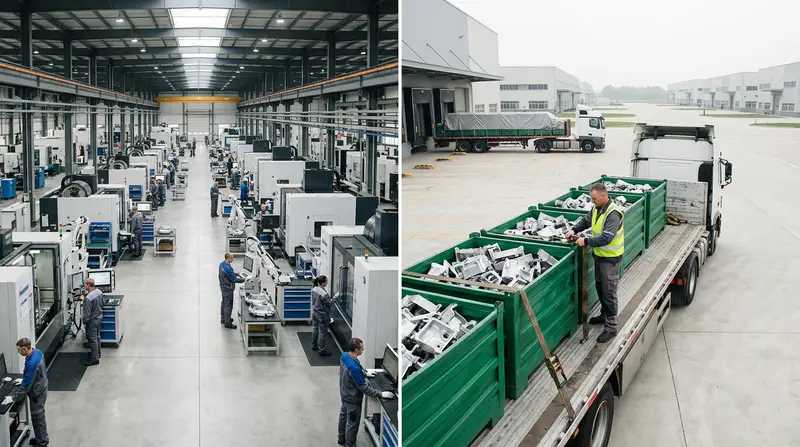
Let’s break it down to see where the difference lies: When outsourcing separately, it takes 1 to 3 days to transport the rough castings from the foundry to the CNC shop; After the CNC shop receives the shipment, it must conduct another incoming quality control (IQC) inspection, which takes another half day to a full day; since the two facilities use different reference planes for clamping, cumulative tolerances can easily exceed specifications. An integrated manufacturing facility eliminates these steps, standardizes reference planes, and significantly reduces the rework rate.
| comparison dimension | Foundry + Outsourced CNC | In-house CNC Integration |
|---|---|---|
| Logistics Hub | 1–3 days shipping | 0 days (same campus) |
| Incoming Quality Control (IQC) | Please repeat this once. | Exemption |
| Tolerance Consistency | ±0.1 mm (common) | Stable within ±0.05 mm |
| Re-work Rate | Higher (no uniform benchmark) | Lower (Uniform Benchmark) |
Ningbo Hexin recommends that, for items such as automotive parts that require a CPK (Process Capability Index) of ≥1.33, priority should be given to integrated suppliers to ensure that tolerances are controlled simultaneously at both the casting and machining stages.
What technical parameters should be considered when evaluating a supplier’s CNC equipment and machining accuracy?
When evaluating Chinese aluminum casting suppliers based on their capability to operate their own CNC machining equipment, start by examining four key metrics: the number of machine tool axes, positioning accuracy, repeatability, and the process capability index (CPK). According to a 2026 supplier evaluation guide, automotive orders require a CPK of ≥1.33 for critical dimensions, meaning that machining dimensional variations must be significantly smaller than the tolerance band specified in the drawings in order to align with the OEM’s quality system.
How do I choose between a 3-axis, 4-axis, and 5-axis machine?
Three-axis machine tools can only move the cutting tool along the X, Y, and Z axes, making them suitable for flat surfaces and simple hole patterns. Four-axis machines add a rotational axis, enabling the machining of multiple sides in a single setup. Five-axis simultaneous machining controls all five axes simultaneously, allowing for the machining of complex surfaces—such as the angled oil passages in new energy motor housings—without the need for multiple repositioning operations, thereby minimizing cumulative errors. For multi-surface machining of housing-type parts, look for five-axis machines.
What values should be checked for positioning accuracy and CMM inspection?
Positioning accuracy refers to the deviation when a cutting tool moves to a specified coordinate, while repeatability refers to the consistency of returning to the same point repeatedly; the latter is a better indicator of machine tool stability. Common requirements for automotive orders include: positioning accuracy of ±0.01 mm and repeatability of ±0.005 mm. Finished products must be tested using a CMM (coordinate measuring machine, which scans geometric and dimensional tolerances point by point with a probe) to generate an inspection report. Ningbo Hexin recommends including CPK targets and AQL sampling standards for each batch in the quality agreement; written commitments alone are not sufficient.
What items should overseas buyers check during a remote factory audit?
When overseas buyers conduct remote factory audits, they must verify six key items: equipment models and quantities, evidence of monthly production capacity, retained quality inspection records, first-article inspection (FAI) reports, batch traceability, and on-site audit documentation. According to a 2026 procurement guide for Chinese aluminum casting suppliers, factories with a monthly production capacity of less than 50,000 pieces experience significant fluctuations in delivery times when handling large-volume orders; therefore, production capacity data should be listed as a mandatory verification item.
- List of equipment: We require the CNC machine model, number of axes, serial number, and purchase invoice—from a genuine, independent Chinese aluminum casting supplier that owns its own CNC machining equipment and can verify each unit individually.
- Monthly Production Capacity Data: Consider the tonnage capacity of the die-casting machines, as well as the automatic pouring and part-removal systems. Factories with a monthly production capacity exceeding 200,000 units are typically equipped with automated production lines.
- Quality Inspection Records: AQL reports and CPK data for each batch of random inspections (for automotive-related critical dimensions, CPK must be ≥1.33).
- First Article Inspection (FAI):First Article Inspection—a report detailing the dimensional inspection of the first article prior to mass production; mass production begins only after the mold is confirmed to meet specifications.
- traceability: The furnace number, shift, and machine number for each box of parts allow for traceability to the specific batch in case of a problem.
If you are unable to attend in person, start with a video audit: have the other party turn on their camera and walk through the production line from die-casting to CNC, focusing on filming the equipment nameplates and the current work orders. Ningbo Hexin recommends that for large orders, a third-party factory audit (such as an on-site ISO 9001 audit by SGS or TüV) be conducted in addition to the video review, using an independent report to supplement any details that are unclear in the video.
For which procurement projects is it appropriate to choose a supplier that offers integrated casting and CNC services?
For functional parts with tight tolerances, multiple manufacturing steps, and consistent batch quality—such as housings for new energy vehicle powertrain systems and automotive structural components—it is advisable to select a supplier that offers integrated casting and CNC machining services. On the other hand, it is more cost-effective to outsource low-precision, high-volume rough castings (castings that do not require finishing) to separate vendors. According to a 2026 procurement guide, for projects with critical dimensional requirements where CPK ≥ 1.33, outsourcing to an integrated facility can eliminate inter-factory transportation and secondary positioning errors.
Which projects are best suited for an integrated approach?
The flatness of the sealing surfaces on “three-electric” housings (aluminum alloy housings for motors, electronic control units, and batteries) is typically required to be within 0.05 mm, and these parts must also incorporate cooling channels and multiple mounting holes. Such components must undergo precision machining immediately after casting; transferring them to another facility increases the risk of scratches and deformation. Ningbo Hexin’s approach in the field of low-pressure die casting for new energy vehicles is to complete the entire process for these housings—from mold production to precision machining—in a closed-loop system within the same facility. The same principle applies to structural components such as automotive suspensions and steering knuckles, which must both bear loads and meet geometric and positional tolerances.
Which projects are more cost-effective to outsource?
For rough castings such as heat sinks and decorative covers—which only require deburring and do not require machining—choosing a factory that specializes in casting will result in a lower unit price. For high-volume rough casting projects with a monthly production capacity exceeding 200,000 pieces, it is often more cost-effective to separate the casting and machining processes and select the best provider for each than to use an integrated foundry.
Faqs
When it comes to Chinese aluminum casting suppliers equipped with their own CNC machining equipment, buyers most frequently ask about four things: cost, small batch sizes, proof of equipment capabilities, and tolerance limits.The key takeaway is that in-house CNC single-piece machining costs are typically lower than outsourcing, but this requires the factory to have sufficient monthly production capacity. According to a 2026 procurement guide, factories with monthly production capacity below 50,000 units experience significant fluctuations in lead times when handling large-volume orders; be sure to verify this criterion when selecting a supplier.
Which is more expensive: in-house CNC or outsourcing?
When production volumes are stable, having your own CNC machines is more cost-effective. By eliminating logistics costs and the administrative fees associated with handling two separate orders, the unit processing cost is generally 8% to 15% lower. However, very small batches (tens of pieces) are an exception; in such cases, in-house production must account for depreciation and setup time, making it less flexible than outsourcing.
Can you handle small-batch orders? What are the tolerances?
It’s possible. For low-pressure and gravity casting, a single mold modification is sufficient to produce a small batch of 50 to 200 pieces. For critical dimensional tolerances, factories equipped with five-axis machines can consistently achieve ±0.05 mm, with a Process Capability Index (CPK)—a metric measuring machining stability—of ≥1.33. When requesting evidence of equipment, directly ask for three items: the machine tool purchase invoice, the serial number, and monthly maintenance records. If any one of these is missing, it raises suspicion. Ningbo Hexin employs an in-house casting-plus-CNC model for low-pressure aluminum castings used in new energy vehicles precisely to control the accumulation of such tolerances.
Summary and Selection Action List
Verifying whether a Chinese aluminum casting supplier has its own CNC machining equipment requires just three steps to obtain hard evidence: request equipment invoices and a list of fixed assets; request sample part reports that include dimensional tolerances; and arrange a remote video factory audit. According to a 2026 procurement guide, setting the following as mandatory criteria—"the factory has been in operation for at least 8 years, has passed an on-site ISO 9001 audit, and performs both casting and CNC machining on the same premises"—can directly reduce delivery time and quality risks.
Follow these steps in order; don't skip any:
- Request Equipment and Work Order Documentation: We need the machine tool purchase invoice, serial number, and monthly machining work orders—the subcontractor cannot provide these records of its own.
- Request for Sample Tolerance Report: Have the supplier provide a First Article Inspection (FAI) report for the critical dimensions and verify that the Process Capability Index (CPK) is ≥1.33 (with variation well within the drawing tolerance band).
- Arrange a Remote Factory Audit: Watch the video to see the continuous flow from the casting line to the CNC machining center, and confirm that monthly production capacity matches order volume (factories with a capacity of less than 50,000 units should exercise caution when accepting large orders).
Ningbo Hexin recommends the following: For high-tolerance functional components such as the “three-electric” housings for new energy vehicles, prioritize factories that offer an integrated casting and CNC machining process; for low-precision rough castings, consider outsourcing them separately to reduce costs.